
Pest Identification Guide
Researched and written by the PestControlServicesNearby.com editorial team · November 2026 · Built from CDC rodent guidance and university extension publications, listed in full at the end. Where a figure comes from pest control operators instead of an official source, the article says so.
It usually starts faintly, a sweet and rotten smell near one wall that you almost talk yourself out of. Then, over the next two days, it builds until one room is hard to sit in, and yet nothing is visible anywhere. In most cases, a mouse has died somewhere inside the structure of your house, most often inside a wall, and the smell is now doing the talking. How long it lasts, where it is coming from, and whether you should wait, treat it in place, or open the wall are the three questions this guide answers in order.
Quick answer: A dead mouse smell typically lasts a few days to a few weeks, and it ends as the carcass dries out. Honesty first, however: no university or government source publishes an official timeline, because the duration depends on five factors instead (how many mice died, where, the humidity, the airflow, and the size of the animal). Meanwhile, the fastest way to end the smell is to find and remove the carcass using the CDC cleanup method below. If you cannot reach it, ventilation and time will carry you through, although a rat, several mice, or a smell that stops fading after about three weeks changes the decision, as the guide explains.
An unreachable carcass, a possible rat, or a smell in the ductwork is a search and removal job. A local provider can locate it, remove it, and seal the entry point that let the mouse in.
PestControlServicesNearby.com is a connection service that links homeowners with independent local pest control providers. We are not the provider who attends your home.
What a Dead Mouse Smells Like
Homeowners describe the smell in remarkably consistent words: sweet and rotten at the same time, like meat left in a warm bin, sometimes with a cabbage-like or faintly gassy edge. Officially, extension publications keep it simpler, saying only that a rodent that dies inside a wall will “smell awful” (University of Georgia Extension). The strength, meanwhile, follows a pattern that, in fact, helps you identify it. First, the smell builds over one to three days as decomposition gets going. Next, it peaks and holds for several days. Finally, it fades gradually as the carcass dries out. A smell that follows that build, peak and fade curve, strongest around one spot, is, in short, a dead animal until proven otherwise.
Two other smell families get confused with it constantly, however, so check them before you blame a mouse. A musty, urine-like odor that never peaks or fades usually means live mice, not a dead one: UC IPM notes that house mice produce a characteristic musky odor in long-term infestations (UC IPM). Drain and sewer smells, by contrast, rise and fall with water use and weather, and besides that, they centre on bathrooms and floor drains rather than one stretch of wall.
One safety check comes first: if the smell is sharply of rotten eggs or gas, treat it as a possible gas leak rather than a dead mouse. Leave the house, and call your gas utility or emergency line from outside. Dead mouse smell is sweet and rotten; it is never a sharp rotten-egg blast, and it never justifies waiting to find out.
How Long Does Dead Mouse Smell Last?
This is the question almost everyone arrives with, so it deserves a straight answer. University of Nebraska Extension, in its house mouse publication, declines to give a number at all and instead lists what decides it: “whether dead mice will cause an odor depends on the number of mice killed, the location of their death, relative humidity and airflow, the size of the mice, and the sensitivity of the resident’s nose” (Nebraska Extension G1105). Consequently, any site that promises you an exact day count is guessing. What follows, therefore, is the factor framework first, and then the ranges working pest control operators actually report, labeled as operator guidance rather than official fact.
Here is that shape at a glance, first. The stage pattern is the consistent part across every source; the day counts are the operator-reported ranges from the table further down, and the end point is the one point ICWDM states officially.
| Stage | Typical timing, one mouse | What you will notice |
|---|---|---|
| Build | Days 1 to 3 | A faint, sweet and rotten smell near one wall, growing stronger each day |
| Peak | About days 3 to 10 | The smell at full strength; blow flies may gather at a nearby window |
| Fade | Weeks 2 to 3 | The smell weakens day by day as the carcass dries out |
| Gone | Once fully dry | The odor disappears when the carcass has dried out; a rat or several mice can stretch the whole curve toward a month |
Timing is operator-reported and labeled as such below; the dry-out end point is ICWDM’s. In cold weather, moreover, the build can take up to a week to become noticeable, and warmth speeds the whole curve up while making the peak stronger.
The five factors that set your timeline
| Factor | Shorter smell | Longer smell |
|---|---|---|
| Size of the animal | One small mouse | A rat, which carries many times a mouse’s body mass, or a squirrel |
| Number of carcasses | A single mouse | Several mice dead in the same void, a common result of one baiting round |
| Location | An open, reachable spot where the carcass dries fast | A sealed wall void or insulation, where fluids soak in and drying slows |
| Humidity | Dry indoor air | Damp voids, bathrooms and crawl spaces, where decay stays wet and active |
| Airflow | Moving air that dries the carcass and clears the room | Still, closed voids; heating ducts that instead spread the smell house-wide |
Framework: Nebraska Extension G1105, Controlling House Mice. Your own nose is the sixth factor the publication names; consequently, two households can honestly report different durations for the same event.
What operators report, labeled as such
| Source (pest control operators) | What they report |
|---|---|
| Orkin (rodent guides) | A mouse takes about 1 to 2 weeks to decompose; the smell lasts from a few days to several weeks, and it can linger up to about two weeks after the source is removed |
| Peachtree Pest Control | Most mouse odors diminish within a few weeks; an unfound mouse can persist for several weeks |
| Thomas Pest Services | The smell continues until the animal is entirely decomposed or dried out; lingering odor can stick around as long as a month |
Read together, moreover, the operator ranges agree with the extension framework: a single mouse in a dry, aired space is usually a one to two week event, while a rat, several mice, or a damp sealed void can stretch it towards a month. Furthermore, the end point is one thing an official source states plainly. The Internet Center for Wildlife Damage Management, hosted at the University of Nebraska, puts it this way: “as soon as the carcass dries out the odor will disappear”, and larger carcasses take more time to dry out (ICWDM, Identifying and Responding to Wildlife Odors). That drying happens well before nothing but bone remains. Likewise, a mouse in a dry wall void often mummifies instead of rotting fully, and that is precisely why the smell fades rather than stopping overnight. If your smell is still getting stronger after a week, however, suspect more than one carcass, or a larger animal.
One size note also matters for expectations. A rat’s smell is not just stronger, it also lasts noticeably longer, simply because there is far more tissue to dry. Size is also how you read the physical evidence, incidentally: droppings scale with the animal, and our guide to telling mouse droppings from cockroach droppings shows the size ladder that separates mouse evidence from rat evidence.
Where the Smell Is Coming From
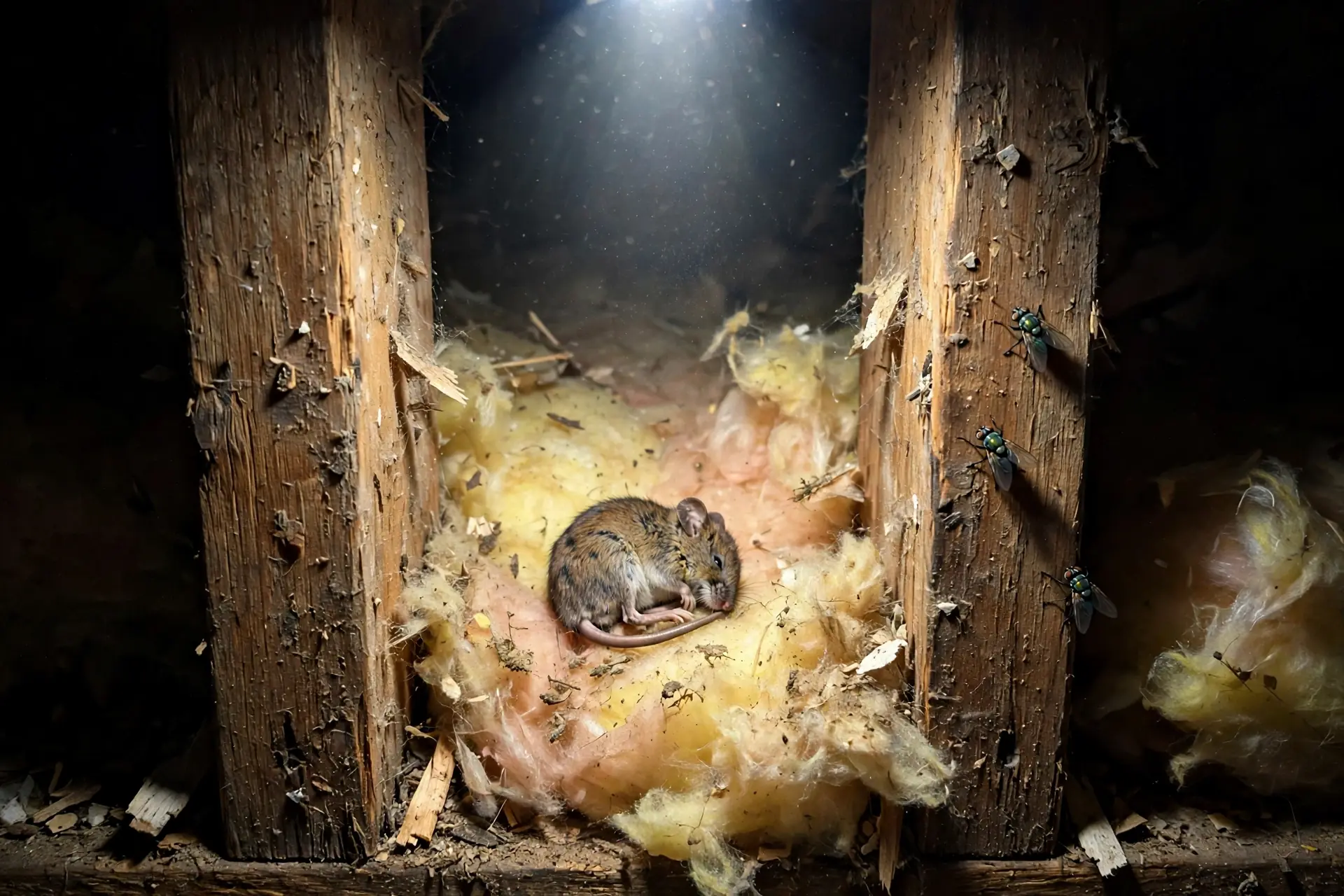
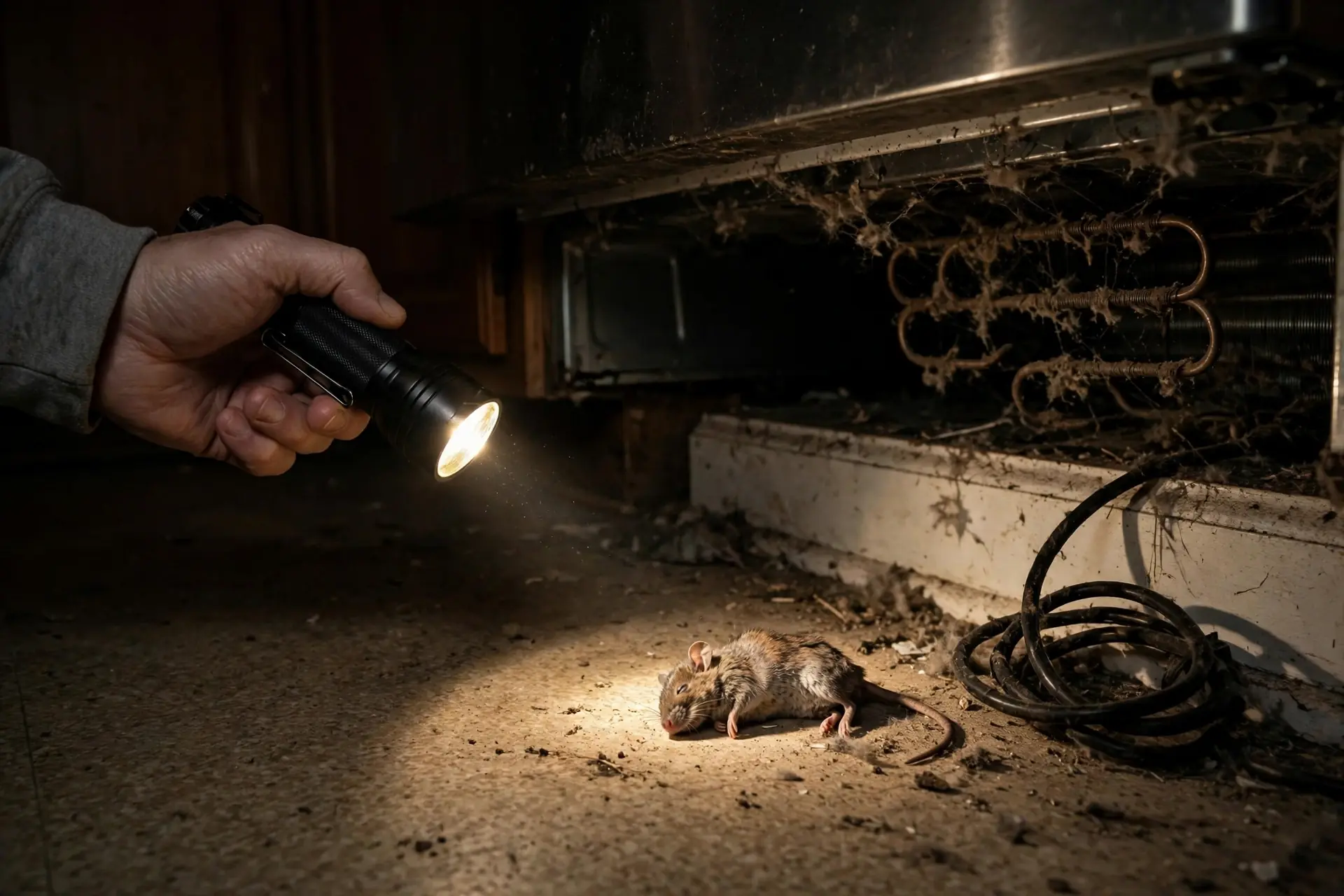
Mice die where they shelter and travel, and therefore the source is almost always a void rather than a room. First of all, wall voids lead the list, especially the base of a wall below a gnawed entry or under a nest. Ceilings and the attic floor come next, where a carcass sits on plasterboard and the smell drops into the room below. Then come the warm, tight harborages: under kitchen cabinets, behind the refrigerator and stove, inside the crawl space, and around ductwork and pipe runs.
One location changes the whole job, meanwhile, namely the ductwork. If the smell surges every time the heating or cooling starts, and it arrives in several rooms at once through the vents, the carcass is likely in or beside a duct, and the system is distributing it. In that case, skip the wait-it-out options below: duct cases belong to a provider with duct access, and the CDC likewise directs duct contamination to a professional service.
How to Find a Dead Mouse You Cannot See
No extension service publishes a carcass-hunting method, so what follows is the standard practitioner approach, labeled as such. It works, in fact, because smell behaves predictably: it pools at the source and leaks out at gaps.
- Map the gradient. Start in the worst room, then work along the wall slowly, nose close to the baseboard. The smell strengthens as you near the source and weakens past it, so then mark the strongest two-foot stretch with tape.
- Check at different times. Warm afternoons and heating cycles push air out of voids and intensify the smell, whereas a cool morning can hide it. Recheck your marked spot at the warmest time of day to confirm it.
- Watch for blow flies. Green or blue bottle flies gathering at one window, or appearing indoors in winter, are a classic carcass clue, because the adults home in on the source to lay eggs. A cluster centred on one wall section supports your marked spot.
- Check the easy wins first. Before assuming a wall void, look behind the refrigerator and stove, under the sink cabinet, inside bait stations and snap traps you set, and along the attic edge above the room. Consequently, many “in the wall” mice turn out to be reachable after all.
- Use sounds as a cross-check. If you also heard activity before the smell started, the timing connects the two events. Our guide to scratching noises in the attic at night covers the sound side, including which noises mean the problem is still alive and moving.
How to Get Rid of the Smell
If you can reach the carcass
Removal is the only instant fix. Even so, it has to be done the safe way. The CDC’s rodent cleanup guidance exists because the risk sits in the droppings, urine and nesting material around the carcass, not in the smell itself, a distinction the safety section explains. Follow the CDC sequence:
- First, glove up. Put on rubber or plastic gloves before touching anything; the CDC sequence starts there for a reason.
- Never sweep or vacuum dry material. Dry sweeping or vacuuming stirs droppings, urine and nesting dust into the air, and that contaminated air is the main infection route the CDC warns about. Everything gets wet-cleaned instead.
- Soak, then lift. Spray the dead rodent and the surrounding area until very wet, wait the five minutes above, then pick everything up with paper towels.
- Double-bag and bin it. Seal the carcass and towels in a plastic bag, place that bag inside a second one, and put it in a covered outdoor garbage can.
- Clean what it touched. Mop or sponge hard surfaces with the disinfectant. If exposed insulation is contaminated with urine and droppings, the CDC says to bag that insulation and remove it, working from outside and staying upwind where the setup allows.
- Wash in the right order. Wash your gloved hands with soap and water first, then remove the gloves and wash your bare hands again.
Sequence: CDC, How to Clean Up After Rodents. Nebraska Extension adds a field trick worth knowing: spray the carcass with disinfectant, turn a sealable bag inside out over your gloved hand, grab the mouse through the bag, then pull the bag right side out and seal it, so your gloves never touch the outside of the bag.
If you cannot reach it
Sometimes, however, the carcass sits mid-wall with no access panel, and opening up is not yet justified. In that case the strategy flips: you cannot remove the source, so you dry it faster, clear the room air, and protect your nose meanwhile.
- Ventilate, because it does double duty. Airflow is one of Nebraska Extension’s five duration factors, so moving air both dilutes the smell today and dries the carcass sooner. Open windows on both sides of the room when weather allows, and run a fan blowing room air outwards.
- Absorbers help a room, not a wall. Activated charcoal bags and baking soda are the practitioner staples here. Honestly labeled: no extension source validates them for carcass odor, and they absorb only what reaches them, so place them near the baseboard of the worst wall and expect partial relief, not a cure.
- Vinegar does not remove it. A bowl of vinegar is the most suggested folk remedy of all, yet it only adds a competing smell. The carcass keeps decaying regardless, so treat vinegar as masking, like a scented spray, and a weak one at that.
- Enzymatic cleaners work on contact, not through walls. These products digest organic residue they can touch, which makes them genuinely useful on a reachable floor or cabinet spot after removal. Sprayed near a sealed void, however, they reach nothing that matters.
- Ozone generators are the marketed shortcut; stay skeptical. Homeowners reach for ozone machines and ozone bombs often, cars especially, yet ICWDM notes it has not been able to get a firm scientific handle on the validity of ozone deodorizing claims. Ozone cannot reach a carcass sealed inside a wall in any case, so at best it treats room air while the source carries on decaying.
- Seal the leaks, not the mouse in. Caulking baseboard gaps on the room side slows smell leaking out of the void. Do not, by contrast, seal exterior entry holes while mice may still be inside, or the next carcass is already scheduled; entry sealing belongs after the smell event ends, and the prevention note below covers it.
Open the Wall or Wait It Out?
Admittedly, cutting drywall sounds drastic, yet sometimes it is the shortest route out of a month of smell. Use the decision table, which combines the factor framework with the operator experience above.
| Your situation | Decision | Why |
|---|---|---|
| A single mouse, the smell peaked already, and it fades a little each day | Wait it out | The curve says the carcass is drying; most of the event is behind you, and ventilation shortens the rest |
| You cannot reach it, the smell is mid-strength, and its location is uncertain | Treat in place | Ventilate, run absorbers at the baseboard, and re-map the gradient daily; opening a wall blind usually misses |
| The location is pinned to one small wall section, and the smell is severe or not fading after about three weeks | Open the wall | A neat cut at the marked section, removal, disinfection and a patch ends it the same day; operators do exactly this |
| A rat or larger animal, several carcasses, a carcass in ductwork, or live scratching sounds continuing | Call a provider | Bigger carcasses justify professional removal, ducts need specialist access, and continuing sounds mean a live infestation sits behind the smell |
One boundary is worth stating plainly: never cut into a wall near wiring, plumbing or a chimney flue on a guess, and never cut at all if the gradient will not pin the spot. A provider with a borescope settles the location through a hole the size of a coin, which is another reason the pinned-location row above ends at a small, confident cut rather than exploratory demolition.
Why This Usually Starts With Poison
Indeed, most dead mouse smell stories begin the same way: bait went down, the scratching stopped, and then the smell arrived. University of Georgia Extension explains the mechanics bluntly: poisoned rodents do not die immediately; instead, they usually crawl into an inaccessible space in a wall or behind appliances and then “smell awful”. Penn State Extension adds the second cost, noting that rodents dying inside walls also attract insect pests, which is where the blow flies come from. Nebraska Extension, meanwhile, dismisses the comforting myth that poisoned mice wander outside to die: predictions about where they will die are impossible, and the hopeful versions are “little more than hopeful speculations”.
That is why, in fact, all three sources land in the same place: traps inside the house, not poison. Nebraska Extension lists trapping as the preferred home method partly because it “allows for disposal of trapped mice, thereby eliminating the potential for odors from the mouse carcasses”. In other words, a snap trap in the open is not just kinder to your walls; rather, it is the difference between a five-minute disposal and a three-week smell. If live mice are still active in your home, our mouse trapping and entry-point sealing pillar covers the trap placement and the sealing that stops the next mouse, and it is the right next read after the smell clears.

Owner reports, not professional diagnoses. The same patterns repeat across the threads. First, the smell that “will not go away” almost always resolves, on inspection, into a second carcass or a rat rather than a mouse. Second, cars and campers generate a steady stream of cases, because a mouse that dies in a vehicle wall or duct has nowhere for the smell to escape. Third, posters who baited indoors warn the next reader off it in nearly the same words the extension publications use. Finally, the wait-it-out reports cluster around one to three weeks for a single mouse, which matches the operator ranges in the duration section above.
Is Dead Mouse Smell Harmful?
The careful answer, in short, separates the smell from the material. No CDC or extension source says the odor itself makes people ill; the smell is a nuisance and a warning sign, not the hazard. The real hazard, instead, is what cleaning can stir up. The CDC explains that when fresh urine, droppings or nesting material from an infected rodent are disturbed, virus particles can become airborne, and breathing that contaminated air is the main route of hantavirus infection (CDC, Hantavirus Prevention). Hantavirus is rare but serious: 890 laboratory-confirmed US cases were reported between 1993 and 2023. That rarity, combined with that severity, is exactly why the wet-cleaning protocol above matters more than any air freshener.
The practical rules are simple, therefore. Never handle a carcass bare-handed. Never sweep or vacuum a dry nest, droppings or a carcass area. Keep children and pets away from the cleanup zone until surfaces are disinfected and dry. And if anyone in the house develops flu-like illness with fever in the days after handling rodent material, Nebraska Extension advises seeking medical care and mentioning the exposure. Beyond that, stop the DIY route when the carcass is large, when it sits in ductwork, or when droppings and nesting are extensive, because those three cases multiply the contaminated material you would have to disturb.
Stop the Next One
Once the smell has fully ended, prevention is what stops the sequel, because, after all, a mouse that died inside found a way inside. The CDC’s sealing guidance starts with a memorable scale: a mouse can fit through a hole the width of a pencil, about 1/4 inch or 6 millimeters (CDC, How to Seal Up). University of Georgia Extension sets the bar slightly differently, at openings as small as a dime, so work to the tighter CDC figure and you satisfy both. Fill small holes with steel wool packed tight and caulked or foamed around, and cover larger gaps with hardware cloth, lath screen or metal sheeting, since mice chew through foam alone. Then remove the invitations: food in thick sealed containers, pet food put away overnight, and garbage in cans with tight lids. Only seal, however, once you are confident no live mice remain inside, otherwise the sealing itself creates the next wall carcass.
Common Mistakes
| Mistake | Why it backfires | Do this instead |
|---|---|---|
| Putting poison bait indoors to solve a mouse problem | Poisoned mice die in walls and behind appliances, converting a trapping job into weeks of smell (Georgia and Penn State Extension) | Use snap traps indoors, where carcasses stay reachable, and keep bait for outdoor use away from children and pets |
| Sweeping or vacuuming up droppings and nesting | Dry disturbance throws contaminated dust into the air, the main infection route the CDC warns about | Ventilate for 30 minutes, then wet everything with disinfectant and lift it with paper towels |
| Spraying air freshener and declaring victory | Masking scents fade in hours while the carcass keeps decaying for weeks, so the smell returns stronger each time | Remove the source if reachable; if not, ventilate and run absorbers at the baseboard while it dries |
| Sealing entry holes during the smell event | Any live mice still inside are trapped in, and the next carcass is created by the repair itself | Wait until the smell ends and activity stops, then seal to the CDC pencil-width standard |
| Cutting the wall on the first bad day | Early cuts are guesses, because the gradient is weakest before the smell peaks and maps properly | Map the gradient at the warmest time of day first; cut only when one small section is pinned and the table above says open |
Questions Homeowners Ask
Will dead mouse smell go away on its own?
Yes, it will. Ultimately, the smell ends as the carcass dries out, and a single mouse in a reasonably dry, aired home usually completes that cycle within one to two weeks of the smell starting. Ventilation speeds it up, because airflow is one of the factors governing how fast the carcass dries. It only fails to go away when the source is bigger than assumed, when several carcasses are present, or when fluids have soaked deep into insulation or flooring, and those cases need removal rather than more patience.
How long does a dead mouse smell bad for?
Typically, the range is a few days to a few weeks, with the worst of it concentrated in the middle days. No official timeline exists, since Nebraska Extension lists the duration as dependent on the number of mice, the location, humidity, airflow and the animal’s size. Operators consistently report about 1 to 2 weeks for a mouse to decompose, and up to about a month of lingering odor in the worst cases, such as a rat or several mice in a damp void.
I can smell a dead mouse but can’t find it. What should I do?
First, map the smell gradient along the baseboard and mark the strongest stretch, checking again at the warmest time of day. Next, rule out the reachable spots: behind the refrigerator and stove, under the sink cabinet, in the attic above the room, and inside any traps or bait stations. If the source stays hidden, ventilate the room, place absorbers at the baseboard, and let the decision table guide you: wait while it fades, open the wall when one section is pinned and the smell is severe or stale past about three weeks, and call a provider for ductwork or larger animals.
Is inhaling dead mouse smell harmful?
The smell itself, however, is not the route of infection, according to the CDC’s guidance. The risk is breathing air contaminated by disturbed rodent urine, droppings or nesting material, which is how hantavirus spreads. That is why the cleanup rules ban dry sweeping and vacuuming, and why the carcass and its surroundings get soaked in disinfectant before anything is lifted. Normal room exposure to the odor, meanwhile, is a nuisance rather than a medical event.
What will absorb dead mouse smell?
In practice, activated charcoal and baking soda are the two absorbers operators reach for, placed close to the baseboard where the smell leaks out. Honestly, though, they treat the room air, not the carcass, so expect them to soften the smell rather than end it. The only true end is the source drying out or being removed. Ventilation outperforms both, because it clears the room and dries the carcass at the same time.
Will vinegar get rid of dead animal smell?
No, in fact, vinegar will not remove it. Vinegar adds a strong competing odor and can clean a hard surface after a carcass is removed, but it cannot reach or neutralize a carcass sealed inside a wall. While the vinegar smell fades within hours, the decay continues on its own schedule. Spend the effort on ventilation and absorbers instead, which at least work on the room continuously.
Can you leave a dead mouse in the wall?
Yes, in most cases you can, and most households do exactly that. The carcass dries out, the smell fades over one to two weeks in typical conditions, and the void returns to normal. The exceptions matter, though: a rat or several mice can smell for a month and draw blow flies and other insects into the void, and a carcass whose fluids have soaked insulation can leave a residue smell after drying. Those are the cases where opening the wall, or calling a provider, beats waiting.
How do you find a dead mouse in your house?
Instead, follow your nose in a structured way. Start where the smell is strongest, work along the baseboard until it peaks and then fades, and mark that peak stretch. Then cross-check with blow flies gathering at one window, with the time of day the smell surges, and with the warm harborages behind appliances and under cabinets. If the peak sits over ductwork and the smell arrives through several vents, stop searching and call a provider, because duct cases need specialist access.
The Takeaway
A dead mouse smell is unpleasant, but it is also information. In other words, something died inside the structure, most often after poison, and the smell will end when that carcass dries. Meanwhile, your job is only to choose the right lane. If you can reach it, remove it the CDC way and the story ends today. If you cannot, ventilate, absorb, and let the curve fall. And if the animal is large, the location is pinned and severe, or the smell refuses to fade, open the wall or bring in help rather than living with it. Then, finally, seal the entries to pencil width once it is over, so the next mouse never gets the chance.
Cannot Find It, or Suspect a Rat?
We connect homeowners with independent local pest control providers who locate and remove dead rodents, treat the void, and seal the entry points. Availability and pricing are set by the provider who attends. The line is answered 24/7.
When the animal that died is bigger than a mouse, a rat, a raccoon or a squirrel, it falls under animal removal instead, and our wildlife removal page covers how a provider locates and removes a larger animal and treats the space afterward.
Call (844) 434-2186PestControlServicesNearby.com is a connection service that links homeowners with independent local pest control providers. We are not the attending provider.
Sources
- CDC, How to Clean Up After Rodents (updated April 2024)
- CDC, Hantavirus Prevention (reviewed May 2024), including the 890 laboratory-confirmed US cases reported from 1993 to 2023
- CDC, How to Seal Up to Prevent Rodents (updated April 2024)
- University of Nebraska Extension, Controlling House Mice (G1105)
- Internet Center for Wildlife Damage Management (University of Nebraska), Identifying and Responding to Wildlife Odors
- University of Georgia Cooperative Extension, Rats and Mice: Get Them Out of Your House and Yard (Circular 970)
- Penn State Extension, Is There a Mouse in the House? Eliminate Mice with IPM
- UC IPM, House Mouse (updated July 2025)
Transparency note: the duration ranges in the labeled operator table come from pest control company guides (Orkin, Peachtree Pest Control and Thomas Pest Services), not from the official sources above, because no university or government source publishes a dead-rodent smell timeline. The two article images are AI-generated photorealistic illustrations, not photographs of a real property. PestControlServicesNearby.com is a connection service that links homeowners with independent local providers; we do not attend homes.
Service Disclaimer: PestControlServicesNearby.com is a free service to assist homeowners in connecting with local service providers. All contractors/providers are independent and PestControlServicesNearby.com does not warrant or guarantee any work performed. It is the responsibility of the homeowner to verify that the hired contractor furnishes the necessary license and insurance required for the work being performed. All persons depicted in a photo or video are actors or models and not contractors listed on PestControlServicesNearby.com.
Same-day and 24/7 emergency services are subject to provider participation, location, technician availability, and demand. Availability is not guaranteed and may vary by market and appointment capacity.