Pest Identification Guide
Researched and written by the PestControlServicesNearby.com editorial team · November 2026 · Built from CDC and university extension identification guidance, listed in full at the end.
You opened a kitchen cabinet and found them: small dark pellets behind the cereal boxes, or a scatter of black specks around the hinge. They were not there last week. Two very different pests leave signs like these, and the fix for each is completely different, traps and sealed gaps for one, sanitation and bait for the other. Guessing wrong wastes weeks while the real problem keeps growing.
Quick answer: Cockroach droppings vs mouse droppings comes down to surface and ends. Mouse droppings are smooth, rice-shaped pellets 1/8 to 1/4 inch long with pointed ends. Cockroach droppings are never smooth: large roaches leave blunt-ended pellets about 1/8 inch long with fine ridges running lengthwise, and small roaches leave only specks like ground pepper, often smeared into spots. If a pellet is smooth and pointed, think mouse. If it is ridged, blunt, or just a speck, think roach. Size alone cannot settle it, an American cockroach pellet and a small mouse dropping are the same length.
PestControlServicesNearby.com is a connection service, not the provider. Availability, pricing and scheduling are set by the independent professional you choose.
The 60-Second Identifier
Cockroach droppings vs mouse droppings is a five-check problem, and the order matters. Run the checks in sequence, the first two settle most finds, and the later ones break the ties. You do not need to touch anything: a phone flashlight and a coin for scale are enough.
- Size. Compare against a coin or ruler. Specks under about 1/16 inch, like ground pepper or coffee grounds, are cockroach, full stop; mice never leave anything that small. Pellets of 1/8 inch or longer need the next checks.
- Ends. Mouse droppings taper to a point at one or both ends, like grains of dark rice. Roach pellets are cut off blunt, almost rectangular. Pointed ends are the single fastest mouse tell.
- Surface. Look at the sides with the flashlight held low. Mouse droppings are smooth. Every cockroach in the CDC’s pictorial key to droppings leaves ridges running along the pellet, fine lengthwise lines you can catch in raking light. Ridges rule out mice.
- Smears and spots. Roaches also leave dark spots and smear marks where they gather and travel, on cabinet hinges, along seams, around pipe openings. Mice leave no smears. Spotting on a vertical surface is roach evidence even if you never find a pellet.
- Pattern and place. Mice drop pellets along their routes: in lines along walls and the backs of cabinets, a few at a time in the same spots. Roaches cluster droppings where they hide: inside hinge corners, drawer seams, behind the refrigerator. A group tells the story better than any single pellet, the CDC key itself is built on judging a group of droppings, not one.
Side-by-Side: Mouse vs American Cockroach vs German Cockroach
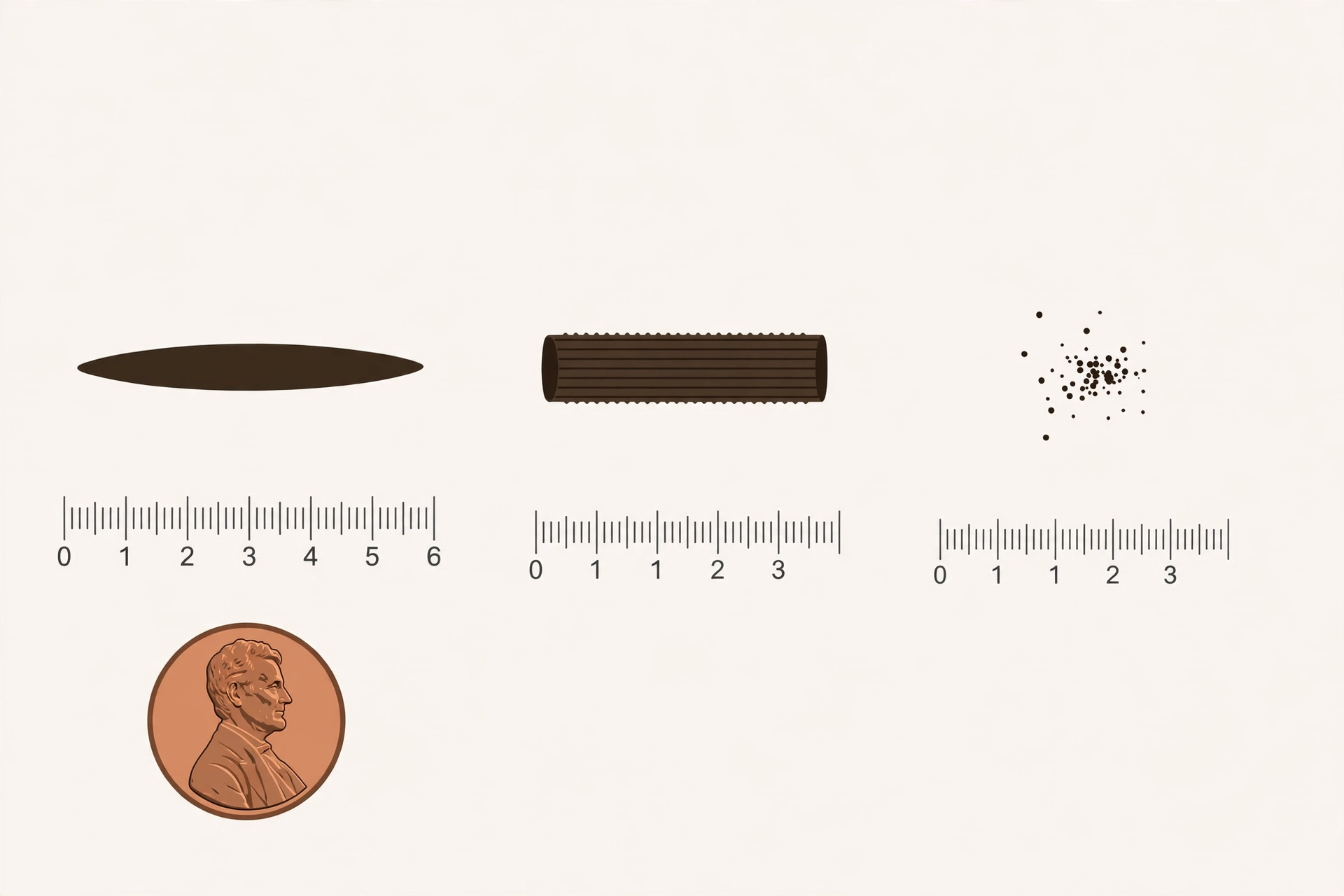
Three suspects account for nearly every kitchen find. The small roach on the right is included because its specks are the most common cockroach sign of all, and the one nobody mistakes for a mouse once they know it exists.
| Feature | House mouse | American cockroach (large roach) | German cockroach (small roach) |
|---|---|---|---|
| Length | 1/8 to 1/4 inch (3 to 6 mm) | About 1/8 inch (about 3 mm) | About 1/16 inch (about 1.5 mm), specks, not pellets |
| Shape | Rod-shaped, like a grain of dark rice | Short cylinder, almost rectangular | No fixed shape, dots and specks |
| Ends | Pointed or tapered at one or both ends | Blunt, cut off flat | Not applicable |
| Surface | Smooth, no lines | Fine ridges running lengthwise | Specks often merge into spots or smears |
| Colour | Dark brown to black; grey and brittle with age | Dark brown to black | Black to dark brown |
| Typical pattern | Scattered along travel routes, in lines or small groups, a few in the same spot night after night | Loose pellets near damp hiding places, basements, drains, behind appliances | Tight clusters where roaches gather: hinge corners, seams, drawer edges, around motors |
| Smearing | None | Occasional spots | Common, dark fecal spots and smears on surfaces |
Size figures follow the CDC’s pictorial key to droppings (average dry droppings of adults) and extension guidance; individual droppings vary, so judge a group, not a single pellet.
The Overlap Zone: When Size Alone Fails
Here is the trap that catches most people. The CDC key puts an American cockroach dropping at about 1/8 inch, exactly the bottom of the mouse range. A small mouse dropping and a large roach pellet can be the same length, the same colour, and found in the same cabinet. Anyone who identifies by size alone will call these wrong half the time, and some published size charts make it worse by printing overlapping ranges with no tiebreaker.
Three tiebreakers work in the overlap zone, in this order:
- Ridges. Decisive. Lengthwise ridges mean cockroach; mouse droppings are smooth. Use the flashlight test from the identifier, ridges show up as fine parallel lines in low, angled light.
- Ends. Blunt and rectangular leans roach; tapered and rice-like leans mouse. Ends can be damaged on a single pellet, which is why this ranks second.
- Company they keep. Pellets plus pepper specks or smears anywhere nearby means roaches are present whatever one pellet looks like. Pellets plus gnaw marks, shredded nesting material, or a line of droppings along a wall means mice.
Where You Found Them: Pattern Is Evidence
Location narrows the answer before you look closely at a single dropping. Roaches leave evidence where they hide; mice leave evidence where they travel.
Cabinet hinges, corners and seams
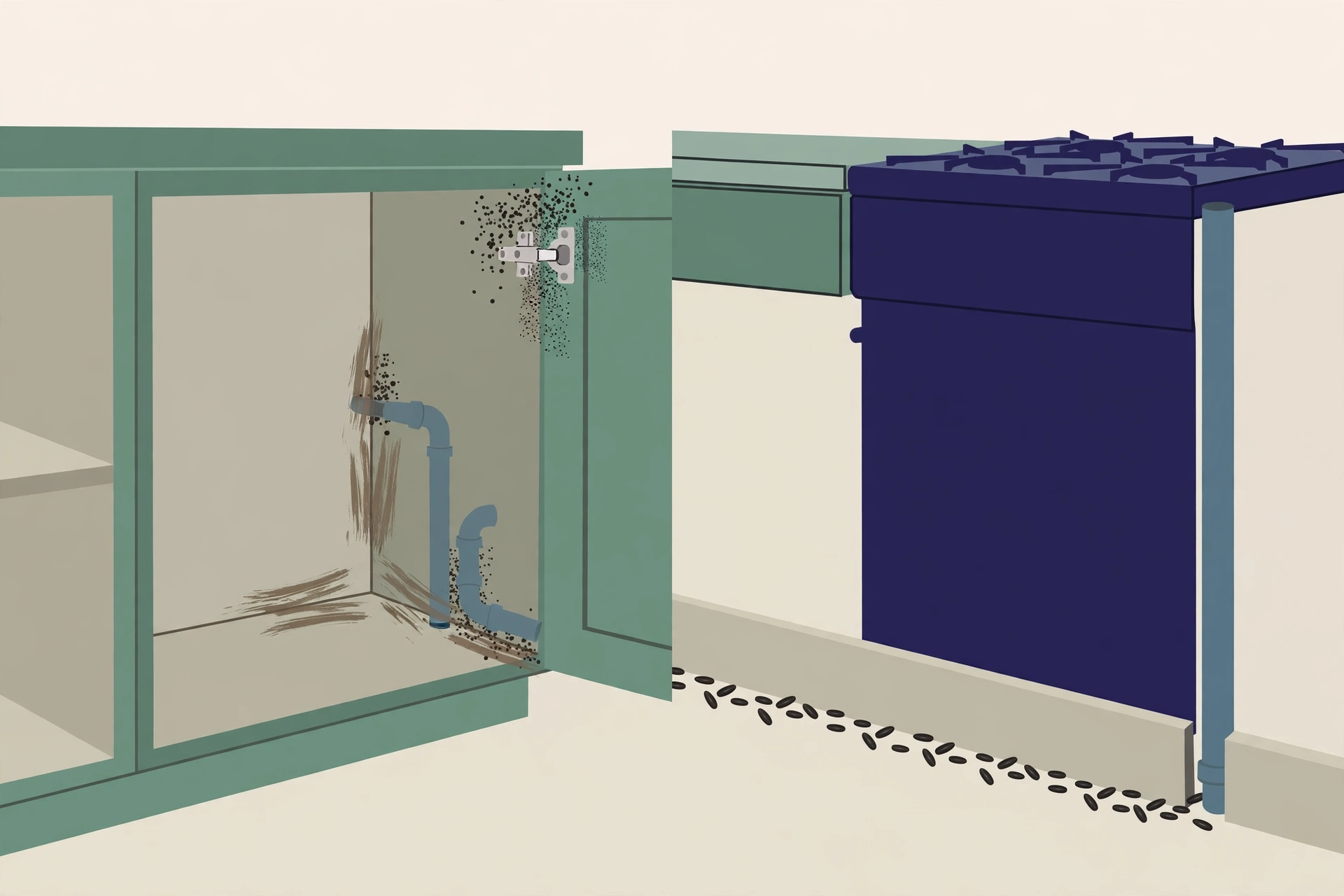
Specks clustered here are the classic German cockroach signature. UC IPM describes cockroach evidence as accumulations of fecal matter, dark spots or smears, where the insects congregate. Check the hinge side of every kitchen cabinet door.
Along walls and the backs of cabinets
A scattered line of pellets following a wall or the back edge of a shelf is a mouse route. Mice travel the same paths nightly and drop pellets as they go, a few in the same spot, night after night.
Under the sink and around pipes
Both pests use plumbing areas, water for roaches, entry gaps for mice. Look at what accompanies the droppings: smears and specks point to roaches; pellets plus a gap around a pipe points to mice.
Behind the refrigerator and stove
Warm motors shelter roaches; the floor gap shelters mouse routes. Pull the appliance out only if it moves easily, photograph what you find, and note which pattern from the table it matches.
The Suspects, One by One
House mouse
The pellet-maker. Droppings 1/8 to 1/4 inch, smooth, pointed at the ends, dropped along routes and near food. Confirming signs: gnaw marks about 1/12 inch wide, shredded paper or insulation nests, and scratching sounds after dark. Mice are night-active and breed fast, UC IPM puts a female at 5 to 10 litters a year.
American cockroach
The pellet-maker on the roach side, and the source of nearly all the confusion. Its droppings are blunt cylinders about 1/8 inch long with ridges down the sides. The insect itself is a large outdoor-leaning roach of basements, drains and sewers that forages indoors; a few pellets near a drain or basement door can mean visitors, not a breeding indoor population.
German cockroach
The speck-maker. Droppings are pepper-like specks about 1/16 inch that stick where roaches gather and build into spots and smears. This species lives and breeds entirely indoors, favouring kitchens and bathrooms, UC IPM calls it the most common indoor cockroach. Specks mean a harborage is close, usually within a few feet.
Probably not either: rat droppings and egg cases
Rat droppings are in another size class entirely, roughly 1/2 inch and up, so anything rice-sized is not a rat. The other lookalike is the cockroach egg case: a single smooth capsule about 1/4 inch (German) to 3/8 inch (American), far bigger and more regular than any dropping. Finding cases, not just droppings, means roaches are breeding on site.
What the Droppings Tell You
- Fresh or old? Fresh mouse droppings are dark and soft; old ones turn grey, hard and crumbly, CDC’s rodent guidance uses exactly this to judge whether activity is current. Roach specks are harder to age, but specks on a surface you cleaned yesterday are fresh by definition.
- How many, how fast? Droppings that reappear in the same spot within a day or two mean an active route or harborage nearby, whichever pest made them. A single scattering that never grows is more likely a one-off visitor, clean, then watch for a week before concluding anything.
- Where is the source? Roach evidence concentrates at the harborage, the cluster centre is usually within a few feet of where they hide. Mouse pellets mark a route; the nest is often 10 to 30 feet away along the same line, in a wall void, appliance base or stored clutter.
- Sound completes the picture. Droppings alone rarely tell the whole story. Pellets in the kitchen plus scratching noises in the attic at night or inside walls points to rodents living in the structure, a bigger job than a few traps under the sink.
Health Risks, in Official Numbers
Neither pest’s droppings belong anywhere near food, but the risks are different in kind, and the official figures below are the ones worth knowing.
For mice, the concern is what droppings and urine can carry, hantavirus above all, plus salmonella and other bacteria, and the risk rises when dried droppings are disturbed and their dust is breathed in. That is why the cleanup method below is not optional detail. For cockroaches, the documented concern is allergens: UC IPM identifies indoor cockroach infestations as important sources of allergens and a risk factor for asthma in children, with allergen levels rising alongside infestation density. Cockroaches that travel through sewers, including the American cockroach, can also carry food-poisoning bacteria such as salmonella onto kitchen surfaces.
Clean Up Safely, Read This Before You Touch Anything
Never sweep or dry-vacuum droppings that could be a mouse’s. Dry disturbance puts contaminated dust into the air you breathe. Until you have ruled mice out, treat every find as rodent waste and use the CDC’s wet method:
- Open windows and doors and let the area air out for about 30 minutes first.
- Put on rubber or plastic gloves.
- Spray the droppings with disinfectant, or a bleach solution of 1.5 cups of bleach in a gallon of water, until they are thoroughly soaked. Wait about 5 minutes.
- Wipe everything up with paper towels, bag the waste, and put it in a covered outdoor bin.
- Mop or wipe the area again with disinfectant, then wash your hands.
Full protocol: CDC, How to Clean Up After Rodents. Once mice are ruled out and the droppings are roach-only, wet-wiping with detergent and removing the debris still matters, cockroach allergen lives in the accumulated material, and UC IPM’s control guidance starts with sanitation for the same reason.

The same kitchen scene opens thread after thread: a few dark pellets near the oven and the fridge, a photo, and one question, mouse or cockroach? Two details settle most of these threads. The first is pattern: pellets that appear a few at a time in the exact same spot, week after week, get identified as a mouse travel route. The second is scale in the photo: one homeowner included a penny beside the find, and the community could immediately separate pellet size from speck size, and pointed to roach-style spotting on the wall as the counter-sign.
The lesson: homeowners who photograph the find with a coin, note exactly where it appeared, and check the nearest hinge and wall usually get a confident answer, from a community thread or a provider, on the first ask.
Community experiences are anecdotes, not diagnoses; the identification checks above follow CDC and extension guidance.
What to Do Next, Based on What You Found
If it is mice
The job is trapping plus exclusion, in that order of urgency: snap traps placed along the routes the pellets revealed, then sealing the entry gaps, mice fit through an opening about 1/4 inch wide, roughly a pencil’s width, per CDC. Poison-free trapping inside living spaces is the standard CDC-recommended approach. See what a full service involves: mouse extermination and trapping.
If it is cockroaches
The job is sanitation plus targeted baiting near the harborage, not broadcast spraying. Remove food and water access, clear the clutter around the cluster centre, and place baits where the specks concentrate. Skip foggers: UC IPM warns they scatter roaches into new hiding places without controlling them. Established German cockroach infestations usually need professional baiting programmes: cockroach extermination services.
If you are still unsure, or found both
Take a clear photo with a coin beside the droppings before you clean, and note the room and surface. A provider can usually identify the pest from that photo and the pattern, then quote the right treatment instead of two wrong ones. Cost depends on which pest it is, how far activity has spread, and whether follow-up visits are needed, identification is what keeps that quote honest.
Not Certain? Get the Droppings Identified Before You Treat
The wrong treatment wastes money twice, once on the product that cannot work, and again on the infestation that kept growing meanwhile. Call to check availability with an independent local provider who can identify what left the droppings and inspect the hiding places behind them.
Call (844) 434-2186PestControlServicesNearby.com is a connection service that links homeowners with independent local pest control providers. We are not the provider: inspections, identification, pricing, scheduling and treatment are handled by the independent professional you choose, and availability varies by area.
Common Mistakes
| Mistake | Why it misleads | Better check |
|---|---|---|
| “It is rice-sized, so it must be a mouse” | An American cockroach pellet is the same 1/8 inch length as a small mouse dropping. | Run the ridge and ends checks before the size check. |
| “The black specks are just dirt or spilled spice” | German cockroach specks cluster at hinges and seams and reappear after cleaning; spilled pepper does not. | Wipe the spot clean and recheck it in 48 hours. |
| Judging from a single pellet | Individual droppings get damaged, bleached or moved; the CDC key is built for groups. | Read the whole pattern, count, spread and company it keeps. |
| “Specks mean roaches, so the pellets must be roach too” | Mice and roaches share kitchens; each sign needs its own verdict. | Run the five checks separately on pellets and on specks. |
| Sweeping or vacuuming the find immediately | Dry disturbance of possible rodent waste puts contaminated dust in the air. | Use the CDC wet method in the cleanup box above. |
| Setting off a fogger for roaches | UC IPM: foggers repel and disperse cockroaches to new hiding places without controlling them. | Bait near the harborage, plus sanitation, or a professional programme. |
Questions Homeowners Ask
How to tell if it’s mouse or cockroach droppings?
Run five checks in order: size, ends, surface, smears and pattern. Mouse droppings are smooth pellets 1/8 to 1/4 inch long with pointed ends, dropped along travel routes. Cockroach droppings are never smooth, large roaches leave blunt, ridged pellets about 1/8 inch long, and small roaches leave pepper-like specks and dark smears where they gather. Ridges or specks mean cockroach; smooth and pointed means mouse.
What do mouse droppings look like vs cockroach droppings?
Mouse droppings look like grains of dark rice: rod-shaped, 1/8 to 1/4 inch long, smooth, and tapered to a point at one or both ends. Cockroach droppings depend on the species. American cockroach droppings are short cylinders about 1/8 inch long with blunt ends and fine ridges running lengthwise. German cockroach droppings are not pellets at all, they are black specks like ground pepper, often merged into spots or smears on surfaces.
How to tell roach poop from mouse poop?
Use a coin and a flashlight. First, anything smaller than about 1/16 inch, specks like ground pepper, is roach. For pellets, check the ends (pointed means mouse, blunt means roach), then hold the flashlight low and look for fine lengthwise ridges on the sides (ridges mean roach, and no mouse dropping has them). Finally, read the pattern: pellets in lines along walls suggest mice; specks and smears clustered at cabinet hinges suggest roaches.
Can you tell the difference between mouse and rat droppings?
Yes, mainly by size. Mouse droppings run 1/8 to 1/4 inch long. Rat droppings are much larger, roughly 1/2 inch and up, so anything the size of a grain of rice is not from a rat. Rat species differ in shape (Norway rat droppings are blunt; roof rat droppings are more pointed), but at kitchen-cabinet scale, the mouse-versus-rat question is settled by length alone.
What does cockroach poop look like?
It depends on the roach. Small species such as the German cockroach leave tiny dark specks resembling ground pepper or coffee grounds, often stuck to surfaces in clusters and building into spots or smears where the roaches gather. Large species such as the American cockroach leave short, dark, cylindrical pellets about 1/8 inch long with blunt ends and ridges along the sides. UC IPM describes the typical evidence as accumulations of fecal matter, dark spots or smears, near hiding places.
Is cockroach poop dangerous?
It is a genuine health concern rather than an emergency. Cockroach droppings and body fragments are a documented source of indoor allergens, and UC IPM identifies cockroach infestations as a risk factor for asthma in children, with allergen levels rising as infestations grow. Roaches that travel through sewers can also carry bacteria such as salmonella onto food surfaces. Wet-wipe droppings rather than sweeping them dry, wash hands afterwards, and treat the infestation itself, removing the allergen source is the point.
How do you clean up droppings safely?
Until you have ruled out mice, follow the CDC’s method for rodent waste: air the area out for about 30 minutes, wear gloves, spray the droppings with disinfectant or a bleach solution (1.5 cups of bleach in a gallon of water) until soaked, wait about 5 minutes, wipe up with paper towels, bag and bin the waste, then disinfect the surface again and wash your hands. Never sweep or dry-vacuum droppings that could be a mouse’s, disturbing them dry puts contaminated dust into the air.
Final Takeaway
Smooth and pointed means mouse; ridged, blunt, speckled or smeared means cockroach, and when a pellet could be either, the ridges settle it. Read the pattern as well as the pellet, clean up the CDC way until mice are ruled out, and treat for the pest you actually have. Cockroach droppings vs mouse droppings is a two-minute identification once you know which features matter; it only becomes expensive when it is guessed.
Ready to Find Out What Is in Your Kitchen?
Call to check availability with an independent local provider for identification, treatment and follow-up. The line is answered 24/7.
Call (844) 434-2186PestControlServicesNearby.com connects homeowners with independent local pest control providers and does not itself perform inspections or treatments. This article is identification guidance based on the public sources below; it is not a substitute for an in-person inspection. Pricing, methods, guarantees and scheduling are set by the provider you choose.
Research Sources and Editorial Transparency
- Scott, H. G. & Borom, M. R., Domestic Rodents and Cockroaches: Pictorial Key to Droppings, in Pictorial Keys: Arthropods, Reptiles, Birds and Mammals of Public Health Significance, US Communicable Disease Center (CDC). Dropping lengths, ends and ridges by species; figures are averages for dry adult droppings, judged as a group.
- UC Statewide IPM Program, Pest Notes: Cockroaches. Fecal spots and smears, egg-case sizes and contents, reproduction figures, allergen findings, sanitation and baiting guidance, fogger warning.
- UC Statewide IPM Program, Pest Notes: House Mouse. Mouse signs, droppings, gnaw marks and breeding rates.
- Centers for Disease Control and Prevention, Hantavirus: Reported Cases. The 890 laboratory-confirmed US cases, 1993 to 2023.
- Centers for Disease Control and Prevention, How to Clean Up After Rodents. The wet-cleaning protocol summarised in the safety box.
- US Environmental Protection Agency, Asthma Triggers: Gain Control. Cockroaches and pests as indoor asthma triggers.
How this page was produced: identification features were cross-checked against the CDC key and university IPM guidance above; the two images are original educational illustrations (specimens enlarged for visibility, as captioned), not photographs of real finds. Homeowner patterns in the community panel are recurring themes from public r/pestcontrol threads, presented as anecdotes. PestControlServicesNearby.com is a connection service, not a pest control operator, and nothing on this page is a diagnosis of your home, when identification matters, a provider can confirm it in person.
Service Disclaimer: PestControlServicesNearby.com is a free service to assist homeowners in connecting with local service providers. All contractors/providers are independent and PestControlServicesNearby.com does not warrant or guarantee any work performed. It is the responsibility of the homeowner to verify that the hired contractor furnishes the necessary license and insurance required for the work being performed. All persons depicted in a photo or video are actors or models and not contractors listed on PestControlServicesNearby.com.
Same-day and 24/7 emergency services are subject to provider participation, location, technician availability, and demand. Availability is not guaranteed and may vary by market and appointment capacity.