It’s 2 a.m., the house is quiet, and there’s scratching in the ceiling above your bed. It starts, stops, then starts again — too deliberate to be the house settling, too light to be someone walking. If you are hearing scratching noises in the attic at night, you don’t need to panic, but you do need a method.
This guide gives you one. Three checks — the sound, the timing, and the location — narrow the culprit down fast. A short daylight check then confirms it with physical signs. You’ll also learn what to do tonight, what not to do, and which professional handles which animal.
Prepared by the PestControlServicesNearby.com Editorial Team · Last updated: November 2026
Light scratching and scurrying in the attic or ceiling at night is most often mice. Heavier scratching with gnawing is more likely rats. Running and rolling sounds in the morning and late afternoon point to squirrels. Heavy thumps, dragging or chattering mean a larger animal such as a raccoon — a wildlife job, not a pest control job. Soft fluttering and squeaking near vents at dusk can be bats, which need special handling (see the safety box below).
A sound alone cannot prove the species. Confirm it in daylight: droppings, gnaw marks, rub marks and entry points tell you far more than any recording.
Call to inquire about independent pest-control providers who can identify what’s making the noise and check your attic safely. The line is answered 24/7, so you can call now, even in the middle of the night.
Independent-provider connection service. Local coverage, services, and appointment availability vary and are not guaranteed.
The 60-Second Identifier: Sound × Timing × Location
Most homeowners try to identify scratching noises in attic at night from the noise alone. That rarely works. Combine all three columns and the answer usually becomes obvious:
Attic noise identifier: match the sound, timing and location.
| What you hear | When | Where | Most likely | Sign that confirms it |
|---|---|---|---|---|
| Light scratching, scurrying, faint squeaks | Night, in fits and starts | Ceiling, attic floor, wall voids | House mice | Rice-sized droppings, finely shredded nesting, musky smell |
| Heavier scratching, gnawing, occasional thuds | Night, often the same routes nightly | Attic, ceiling voids, walls | Rats (roof rats favor attics) | Olive-pit-sized droppings, greasy rub marks, gnaw marks ~1/6 inch wide |
| Fast running, rolling sounds (like a nut rolling) | Early morning and late afternoon | Attic, roof, soffits | Squirrels | Daytime sightings, chewed entry at eaves, nut caches |
| Light scratching, soft rustling | Late at night | Attic, behind walls | Flying squirrels (nocturnal) | Small droppings, entry high on the structure; a wildlife check confirms |
| Heavy thumps, slow dragging, chattering or crying | Night | Attic, chimney, crawl space | Raccoon or opossum | Large torn entry, strong odor, latrine droppings — do not approach |
| Soft fluttering, thin squeaks, scratching in a vent | Dusk, as they leave to feed | Chimney, vents, attic corners | Bats | Guano below a roost (old, dry pellets crumble, showing shiny insect fragments — look only); see safety box |
| Chirping and fluttering in a vent or flue | Daytime | Chimney, bathroom/kitchen vents | Birds | Feathers, nesting at the vent opening |
Why Correct Identification Matters: What the Official Data Shows
Guessing wrong is expensive in both directions — people pay for rodent treatment when a squirrel is the problem, or ignore mice until a small problem becomes a colony. Three published figures explain why early, accurate identification matters:
Source: UC Statewide IPM — Pest Notes: House Mouse (revised July 2025).
Source: UC Statewide IPM — Pest Notes: Bats.
Data context: These figures measure different things, and none predicts your home’s risk. Hantavirus cases are concentrated in western states and linked mainly to deer mice. They justify careful identification and safe cleanup — not alarm.
Scratching Noises in the Ceiling at Night: Why the Ceiling Sounds Different
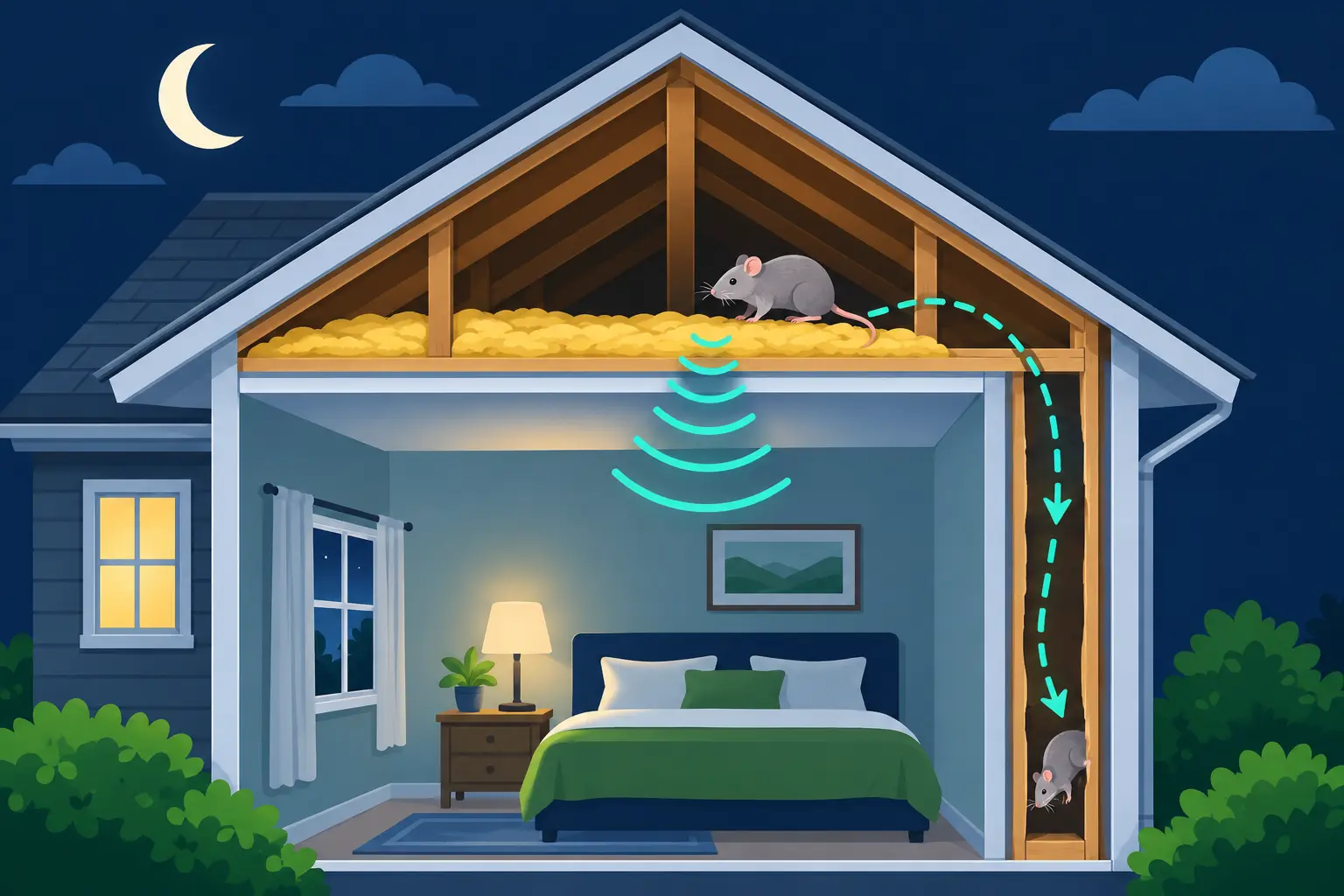
Most nighttime noises are heard through the ceiling — it is the surface between you and the attic. That sound reaches you from two different places, and separating them is your first real clue.
Above the ceiling: the attic floor
If the sound moves across the room and sounds hollow or echoing, the animal is walking on top of the ceiling — on the attic floor or across joists. Scurrying here at night is most often mice; heavier movement with gnawing suggests rats. UC IPM’s rat guidance lists “noises coming from the attic or drop ceilings” as a standard sign of rats, and notes that roof rats nest in exactly these spaces: attics, wall voids and ceiling voids.
Inside the ceiling or walls: the voids
A scratching sound that stays in one patch, or seems to move down a wall, is usually an animal traveling inside the structure. Mice and rats use wall voids as vertical runways between attic and lower levels. UC IPM describes house mice as excellent climbers that run up rough vertical surfaces. That is why a noise can start in the ceiling and end behind a bedroom wall. If you hear scratching noises in a wall at night, think rodent first. One exception: steady daytime ticking or buzzing inside a wall is a different case — that pattern fits yellow jackets in a wall, not rodents. A faint dry rustling in wood can also come from carpenter ant activity in structural wood.
A quick test homeowners use
Tap the ceiling firmly once or twice under the noise. Mice typically freeze, then resume a short distance away; a larger animal usually bolts. Treat this as a rough field check, not proof — log the result, because the pattern over two or three nights is the real evidence.
Identify It by the Sound It Makes
Scratching and scurrying
Quick, light, irregular scratching with short scurrying runs is the rodent signature, and at night it is usually mice. The scurrying noise in a ceiling comes in bursts — activity, silence, activity — because mice move between a nest and food in short trips, mostly within about 30 feet of the nest, according to UC IPM.
Gnawing and chewing sounds
A steadier, rhythmic chewing noise in the attic at night is gnawing. Rodent incisors grow continuously, so rodents gnaw wood, plastic and even soft metals to wear them down. Take this sound seriously: UC IPM notes house mice damage structures by gnawing electrical wires and gas lines, and that many fires of unknown origin are believed to be caused by rodents gnawing wires. The marks also help identification — UC IPM measures rat tooth marks at about 1/6 inch across, versus a mouse’s finer marks of about 1/12 inch.
Loud scratching, thumping and rolling
Loud scratching, thumps and a distinctive rolling sound are rarely rodents. The rolling is usually a squirrel moving or caching nuts — a daytime and early-morning pattern. Heavy, slow thumping at night means a raccoon-sized animal. Rule of thumb: if it sounds too heavy to be a mouse, it is.
Identify It by When You Hear It
- After 10 p.m., in fits and starts: mice. UC IPM confirms house mice are active mostly at night.
- All night, heavier, same routes: rats — also mostly nocturnal, and creatures of habit.
- Dawn and early morning: squirrels leaving to forage, or bats returning to roost. Tree squirrels are day-active and, per UC IPM, most active in early morning and late afternoon — so scratching in the attic in the early morning is a squirrel pattern, not a rodent one.
- Daytime: squirrels or birds, almost never mice or rats. Daytime scratching changes the suspect list completely.
- Day and night: a settled infestation, a mother with young, or more than one species. Log the times for two nights — the pattern is what a professional will ask about first.
The Confirming Signs: What to Check in Daylight
Sounds identify candidates. Signs confirm them. In daylight, with a flashlight, check the attic hatch area and accessible edges for these — UC IPM lists droppings, fresh gnaw marks, tracks, nests and a musky odor as the standard mouse evidence, and the same logic applies to rats:
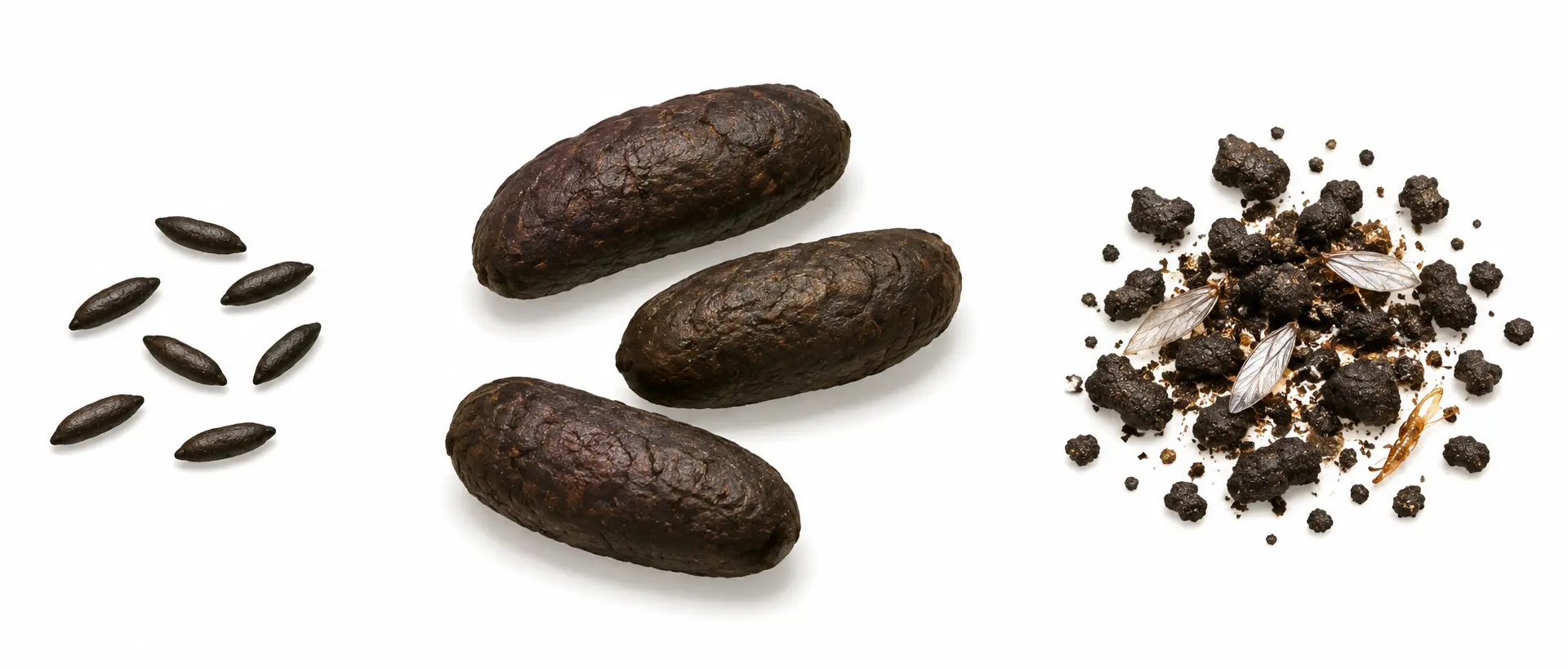
- Droppings. Mouse droppings are rice-sized (about 1/8–1/4 inch) with pointed ends. Rat droppings are olive-pit-sized (about 1/2–3/4 inch) and blunt. Bat guano looks similar to mouse droppings, but old, dry pellets crumble easily and show shiny insect fragments. Look only — never press or handle droppings. Do not handle droppings with bare hands — follow the safety box below.
- Gnaw marks. Fresh marks on wood, pipes or wiring are pale; older marks darken. Measure them: ~1/12 inch suggests a mouse, ~1/6 inch a rat (UC IPM).
- Rub marks. Greasy smudges along beams, pipes and wall edges where rats repeatedly travel — UC IPM lists these smudge marks as a classic rat sign.
- Nesting material. Finely shredded insulation, paper or fabric tucked into a quiet corner.
- Entry points. Check soffits, gable vents, pipe and cable penetrations and roof joints. Remember the CDC’s pencil rule: any gap of 1/4 inch or more is a mouse door.
- Smell. A stale, musky urine odor that is strongest near the nest area.
Found droppings and gnaw marks that point to mice? Identification is only the first half — removal and sealing are the other half, covered by professional mouse trapping and removal.
Found the droppings in a kitchen cabinet rather than the attic? The checks are different downstairs — work through cockroach or mouse droppings to rule roaches in or out.
Safety: cleaning up droppings the CDC way
Never sweep or vacuum dry droppings, urine or nesting material — that puts contaminated dust into the air. The CDC method: ventilate the space for 30 minutes before entering; wear rubber or plastic gloves; spray the material with a household disinfectant (or a fresh mix of 1.5 cups of household bleach in 1 gallon of water) until thoroughly wet; let it soak for 5 minutes; wipe it up with paper towels and bag it; then disinfect the surface. Heavy contamination, or droppings inside heating and cooling systems, is a professional job, not a DIY one.
Noises in the attic but no droppings?
This combination is common, with five honest explanations: (1) the activity is new and droppings haven’t accumulated where you can see them; (2) droppings are hidden under insulation or along runs you can’t reach; (3) the animal is on the roof, not in the attic — audible, but it leaves no indoor sign; (4) the source isn’t an animal at all (next section); or (5) it’s a bat or bird using a vent or chimney. No droppings after two careful checks lowers the odds of an established rodent infestation — it doesn’t clear the house, so keep logging the sounds.
It Might Not Be an Animal at All
Before paying anyone, rule out the house itself. These causes mimic scratching surprisingly well:
Thermal expansion
Ducts, pipes and roof materials expand and contract as they cool at night, producing ticks, pops and light scratching-like sounds — often at the same time each evening, and worse on cold nights.
Plumbing
Water hammer and pressure changes can knock or scrape inside walls after taps or appliances run.
HVAC
A loose duct joint or a blower restarting can thump and rattle in the ceiling.
The roof surface
Branches scraping shingles, loose flashing, or an animal walking on the roof (not in it) — sounds overhead, leaves no attic sign.
The pattern gives it away: mechanical sounds follow temperature, weather or water use, repeat in the same spot, and come with zero confirming signs after two daylight checks. Animal sounds move, vary, and eventually leave evidence.
Species Quick Files: What Each One Does Next
Five animals account for nearly all scratching noises in attic at night. Each file below follows the same pattern — the sound, the timing, the sign that confirms it, the risk, and who to call.
House mice
Sound: light scratching and scurrying.
Timing: night.
Confirming sign: rice-sized droppings, shredded nesting, musky smell.
Risk: fast breeding (5–10 litters a year, per UC IPM), food contamination, wire gnawing.
Correct professional: pest control provider.
Rats
Sound: heavier scratching, gnawing, occasional thuds on fixed routes.
Timing: night.
Confirming sign: large droppings, rub marks, wide gnaw marks.
Risk: structural and wiring damage — UC IPM warns that roof rats nesting in attics present real fire-safety concerns from gnawing and nest-building.
Correct professional: pest control provider; for the exclusion side, see our rat exclusion and foundation sealing guide. Texas A&M AgriLife Extension likewise describes roof rats as the attic-nesting species, traveling the same routes nightly.
Squirrels and flying squirrels
Sound: running, rolling nuts, bold scratching (gray/fox squirrels); softer rustling (flying squirrels).
Timing: gray squirrels are day-active — most active early morning and late afternoon (UC IPM); flying squirrels are the exception and work at night.
Confirming sign: chewed entry at the eaves, daytime sightings.
Risk: chewed wiring and entry holes enlarged over time.
Correct professional: licensed wildlife removal in most areas — squirrels are regulated game animals in many states, so this is not a standard pest control call.
Bats
Sound: soft fluttering, thin squeaks, light scratching near vents at dusk.
Timing: dusk departure, dawn return.
Confirming sign: guano below a roost — old, dry pellets that crumble easily, showing shiny insect fragments (look only; don’t handle).
Risk: rabies — rare (UC IPM cites no more than 0.5% of randomly tested bats), but the consequences of a missed exposure are severe, and bats are protected in many states.
Correct professional: licensed wildlife specialist; exclusion is often season-restricted while flightless young are present.
Raccoons and opossums
Sound: heavy thumps, slow movement, dragging, sometimes chattering or crying young.
Timing: night.
Confirming sign: a large, torn entry point and a strong odor.
Risk: major insulation and duct damage; a cornered raccoon is genuinely dangerous.
Correct professional: licensed wildlife removal — always. Do not approach, and keep pets away from the attic hatch.
Safety: bats and rabies
Never handle a bat, alive or dead, with bare hands. If a bat is found in a room with a sleeping person, a child, or a pet — anyone who cannot rule out contact — do not release it; contact your local health department or animal control for guidance first, because a bite can be too small to see. If you have been bitten or scratched, wash the area with soap and water and seek medical advice promptly. (Source: UC IPM Pest Notes: Bats, which follows CDC rabies guidance.)
What to Do Tonight — and What Not to Do
- Log it. Note the time, the sound type and the location for two or three nights. The pattern is the single most useful thing you can hand a professional.
- Record it. A 30-second phone recording from the bedroom often captures what a daytime visit would miss.
- Run the tap test described above, and note the reaction.
- Check the daylight signs the next morning — droppings, gnawing, entry points — and take the four photos below.
- Keep children and pets away from the attic hatch and any droppings you find.
Four Photos Worth Taking
The attic area or ceiling, showing the full space.
Droppings with a coin beside them for scale.
Gnaw marks or greasy rub marks, close up.
The suspected entry point, photographed from outside.
What not to do:
- Seal the entry hole while something is inside. This is the most common and most costly mistake — a trapped animal dies in a wall void or chews a new way out. The correct order is always: identify → remove → confirm the activity has stopped → then seal. The guide to rodent-proofing the subfloor and crawl space covers materials and method.
- Put poison bait in the attic. A poisoned rodent often dies inside a wall or ceiling void, and the carcass problem is worse than the scratching problem. Common DIY shortcuts also underperform — UC IPM states high-frequency electronic devices are not effective against house mice, and the evidence for DIY peppermint spray for rodents — and its limits and ultrasonic rodent repellers — what the evidence says is weak to nonexistent.
- Handle droppings, nests or bats bare-handed — follow the safety boxes above.
- Climb into an insulated attic at night. Joists are hard to see, ceilings don’t hold weight between them, and a startled animal at face height helps no one.
If the noises repeat, call to inquire about connecting with an independent pest-control provider who can inspect the attic, identify the animal, and explain the next step.
Independent-provider connection service. Local coverage, services, and appointment availability vary and are not guaranteed.
Who to Call: Pest Control or Wildlife Removal?
Not sure whether scratching noises in attic at night mean a pest control call or a wildlife call? The evidence you found decides it:
| If the evidence points to… | Call… | Why |
|---|---|---|
| Mice or rats | A pest control provider | Rodent removal, trapping and entry-point sealing are core pest control work |
| Squirrels or flying squirrels | A licensed wildlife removal specialist | Squirrels are regulated in many states and are usually excluded live, not treated |
| Bats | A licensed wildlife specialist | Protected species in many states; exclusion is seasonal and specialized |
| Raccoons or opossums | A licensed wildlife removal specialist | Size, strength and disease risk make this specialist work |
| Birds in a vent or chimney | A wildlife specialist or chimney professional | Nesting birds may be protected; removal is usually done from outside |
| No animal signs at all | An HVAC or plumbing contractor | The sound is probably mechanical — see the non-animal causes above |
What an inspection or treatment costs depends on the animal involved, attic access, how much exclusion work the entry points need, and whether contaminated insulation must be cleaned or replaced — which is why reputable providers quote after inspecting rather than from a phone description alone.
A professional attic inspection normally checks entry points (roofline, soffits, vents, pipe penetrations), droppings and rub marks, nesting, travel routes, and wiring damage. Ask what evidence they found, which animal it points to, and what they could not inspect — a good provider answers from evidence, not from a script.
Heard Scratching Noises in the Attic or Ceiling at Night?
You’ve done the three checks and logged the pattern. The next step is a proper inspection of the attic and roofline. PestControlServicesNearby.com connects homeowners with independent pest-control providers who can identify the animal and explain your options. For squirrels, bats, raccoons and other wildlife, ask about a licensed wildlife specialist instead — an honest provider will tell you if the job isn’t theirs. The line is answered 24/7.
Call (844) 434-2186PestControlServicesNearby.com connects homeowners with independent pest-control providers. It does not directly inspect or treat homes. Available services, coverage, pricing, and appointments vary by provider and are not guaranteed.
Why Attic and Ceiling Noises Start in Fall and Winter
UC IPM notes that outdoor house mice frequently enter homes in autumn as nighttime temperatures drop — and rats and squirrels follow the same shelter logic. That is why first scratching so often starts in October or November and gets louder through December: the animal has moved in and started nesting. Exclusion before the first hard cold snap prevents the problem; the same work in January means removing residents first. Our guides to crawl space and attic sealing, sealing a crawl space and attic against rodents and crawl-space rodent proofing for winter cover the prevention side in depth.
Five Common Mistakes About Attic Noises
| Common assumption | More accurate explanation |
|---|---|
| “It’s scratching at night, so it must be mice.” | Night scratching can also be rats, flying squirrels, bats or a raccoon. Timing narrows the list; it doesn’t finish the identification — the confirming signs do. |
| “I sealed the hole, so it’s solved.” | Sealing an occupied entry traps the animal inside. Identify and remove first, confirm the noise has stopped, then seal. |
| “No droppings means no animal.” | Droppings hide under insulation and along runs, new activity hasn’t accumulated yet, and some culprits (roof-walkers, bats in vents) leave little indoor sign. |
| “Poison in the attic is the quick fix.” | Poisoned rodents commonly die in wall and ceiling voids, trading a noise problem for an odor and carcass problem. Trapping plus exclusion is the sequence the evidence supports. |
| “A squirrel in the attic at night is just a squirrel.” | Common gray and fox squirrels sleep at night. Night activity points to flying squirrels — or to a different animal entirely. |
Frequently Asked Questions
These are the questions homeowners actually ask about attic noises — including the related question “What animal is making noise in my attic at night?”, which has the same answer as the first question below.
What is making noise in my attic at night?
Most often mice or rats — both are mainly active at night. Heavier sounds suggest rats or a larger animal; soft fluttering at dusk suggests bats. Run the three checks — sound, timing and location — then confirm in daylight with droppings, gnaw marks and rub marks. A sound alone cannot prove the species.
I hear scratching in my ceiling at night — what is it most likely to be?
Light scurrying that moves across the ceiling in bursts is most likely mice; heavier scratching with gnawing leans toward rats on the attic floor or in the ceiling void. If the noise stays in one spot and follows cold evenings or water use, check the non-animal causes first — ducts and pipes imitate scratching well.
How do I stop scratching noises in the ceiling at night?
In this order: identify the animal from its signs, remove it (trapping for rodents, exclusion by a specialist for wildlife), and confirm the noises have stopped for several nights. Only then seal every entry gap of 1/4 inch or more, using metal, hardware cloth or cement — materials rodents cannot chew through. Sealing first, or poisoning, usually makes the problem worse.
What are the signs that rats are in my attic?
Olive-pit-sized droppings, greasy rub marks along beams and pipes, gnaw marks about 1/6 inch wide, shredded insulation used as nesting, and noises from the attic or ceiling at night. UC IPM lists exactly these — droppings, smudge marks, nests and attic noises — as the signs to inspect for.
Why are there noises in my attic but no droppings?
Usually one of five reasons: the activity is new, the droppings are hidden under insulation or along inaccessible runs, the animal is walking on the roof rather than in the attic, the sound is mechanical (ducts, pipes, HVAC), or the culprit uses a vent or chimney instead of the attic floor. Two careful checks with no signs and no droppings make an established rodent infestation less likely — keep logging the sounds either way.
Can mice climb into the ceiling from the walls?
Yes. House mice are excellent climbers that can run up rough vertical surfaces and travel inside wall voids, which is how a noise that starts in a wall ends up in the ceiling. The same routes explain scratching that seems to move between floors during the night.
What could be causing scratching noises in my roof at night?
Two different things: an animal on the roof — a raccoon, opossum or squirrel crossing shingles, or a branch scraping in wind — or an animal in the roof void just under it, which behaves like the attic case above. Roof-surface noises leave no indoor droppings; roof-void noises come with attic signs. Check from the ground with a flashlight rather than climbing up at night.
What does a squirrel in the attic sound like — and would I hear one at night?
A squirrel sounds bolder than a mouse: fast running, scratching at entry points, and a rolling sound as nuts are moved or cached. But common gray and fox squirrels are day animals, most active in early morning and late afternoon — so repeated night noise is usually not a gray squirrel. The night-shift exception is the flying squirrel, a small nocturnal species. If the noise is strictly nocturnal, think mice, rats or flying squirrels before gray squirrels.
Final Takeaway: Identify the Animal Before Choosing the Fix
The decision rule from everything above: if it repeats for two or three nights and daylight signs match, treat it as an active animal problem and get the attic inspected; if it follows cold evenings or water use and leaves no signs after two checks, call an HVAC or plumbing contractor first. Either way, identify before you pay — the wrong fix first is the expensive one.
Need Help With Scratching Noises in Your Attic or Ceiling?
Have you logged the pattern and found droppings, gnaw marks or an entry point? Call to inquire about connecting with independent pest-control providers serving your area. The line is answered 24/7.
Call (844) 434-2186PestControlServicesNearby.com is a homeowner-to-independent-provider connection website, not the company directly performing inspections or treatments. Participating providers determine coverage, available services, pricing, appointment capacity, and recommendations. Availability is not guaranteed.
Research Sources and Editorial Transparency
This article uses government and university sources for its technical information. Homeowner discussions on public forums helped shape the questions covered; those individual accounts are experiences, not confirmed diagnoses.
- UC Statewide IPM Program — Pest Notes: House Mouse (revised July 2025). Night activity, autumn entry into homes, 1/4-inch openings, droppings/gnaw-mark identification, breeding rates, wire-gnawing damage, and why high-frequency devices are not effective.
- UC Statewide IPM Program — Pest Notes: Rats (revised June 2025). Roof rats nesting in attics, wall and ceiling voids; signs of infestation including attic noises and rub marks; gnaw-mark measurements.
- UC Statewide IPM Program — Pest Notes: Tree Squirrels. Daytime activity pattern (most active early morning and late afternoon), attic entry, and legal status.
- UC Statewide IPM Program — Pest Notes: Bats. Rabies risk context, never handling bats, guano identification, and exclusion timing.
- Centers for Disease Control and Prevention — How to Seal Up to Prevent Rodents (April 2024). The pencil-width (1/4-inch) entry rule and sealing materials.
- Centers for Disease Control and Prevention — Reported Cases of Hantavirus Disease. The 890 laboratory-confirmed U.S. cases reported from 1993 through 2023.
- Centers for Disease Control and Prevention — You Can Prevent Hantavirus. Safe cleanup of rodent urine, droppings and nesting material (the method in the safety box above).
- Texas A&M AgriLife Extension — Rodent IPM (Janet Hurley). Roof rats nesting above ground, rodents traveling the same paths nightly, and the identify → remove → exclude sequence.
Editorial disclosure: Any images with this article are original educational illustrations, not photographs of professionally identified infestations in a real home. Forum accounts referenced in the text are publicly shared homeowner experiences whose outcomes have not been independently verified by PestControlServicesNearby.com. This guide provides general homeowner information, not a property-specific inspection or diagnosis.
Service Disclaimer: PestControlServicesNearby.com is a free service to assist homeowners in connecting with local service providers. All contractors/providers are independent and PestControlServicesNearby.com does not warrant or guarantee any work performed. It is the responsibility of the homeowner to verify that the hired contractor furnishes the necessary license and insurance required for the work being performed. All persons depicted in a photo or video are actors or models and not contractors listed on PestControlServicesNearby.com.
Same-day and 24/7 emergency services are subject to provider participation, location, technician availability, and demand. Availability is not guaranteed and may vary by market and appointment capacity.