Pest Identification Guide
Researched and written by the PestControlServicesNearby.com editorial team · November 2026 · Built from university extension guidance, UC IPM, UF/IFAS and Penn State Extension, listed in full at the end.
It looks like a tiny brown purse: behind the fridge, glued under a drawer, or tucked into a cabinet hinge. It is not a dropping and it is not a seed. What you are looking at is a cockroach egg case, one small capsule holding a dozen or more baby roaches, with a hatch date already set. What you do in the next few minutes, and which species it belongs to, decides whether it stays a single case or, instead, becomes the infestation you fight for months.
Quick answer: Cockroach eggs are not laid loose; rather, they come in a hardened, purse-shaped case called an ootheca. Identify yours with three checks: size (about 1/4 inch for German and brown-banded cases, about 3/8 inch for American, Oriental and smokybrown), color (light beige points to German; a case that turns black within two days points to American), and how it got there (German females carry the case until just before hatching; the others, meanwhile, glue it down or drop it near food). In short, one case is never just one case, it is proof of a breeding female nearby.
That pattern means breeding is established, not starting. A local provider can identify the species from the case and treat the harborages behind it.
PestControlServicesNearby.com is a connection service that links homeowners with independent local pest control providers. We are not the treating company, and availability varies by area.
The 60-Second Identifier
In fact, you do not need to touch it. A phone flashlight and a dime for scale are enough, so run these four checks in order.
- Shape. A cockroach egg case is a smooth, hardened capsule shaped like a small purse or a kidney bean, with the eggs packed inside in two rows. UF/IFAS, for example, describes it as a “tiny, brown, purse-shaped capsule.” If what you found is round, fuzzy, papery or crumbles like dirt, it is not a roach egg case; then skip to the confusers below.
- Size. Next, set a dime beside it (a dime is about 0.7 inch across). Small cases, German and brown-banded, run about 1/4 inch long, noticeably less than half the dime’s width. The larger species, meanwhile, run about 3/8 inch: American, Oriental and smokybrown.
- Color. Likewise, light beige or light brown on a small case points to German or brown-banded. Dark red-brown likewise points to Oriental. A case that was brown when you first saw it and has turned black a day or two later is an American case, UC IPM lists that color change as characteristic of the species.
- Carried, glued, or dropped. German females carry the case protruding from the abdomen until 1 to 2 days before it hatches. Consequently, a German case found loose was dropped at the last moment: the female was right there. Brown-banded cases, in contrast, are glued to ceilings, furniture undersides and closet walls. American cases are likewise cemented to a protected surface. Oriental cases are simply dropped in sheltered spots near food. Finally, smokybrown cases are dropped outdoors in leaf litter and mulch.
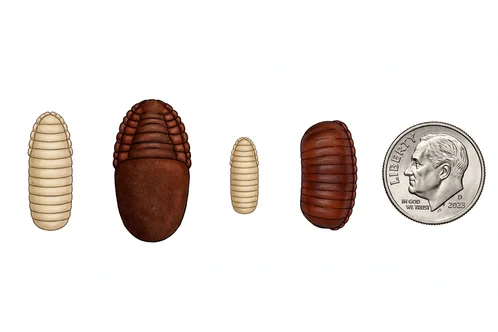
Egg Cases Compared by Species
Every figure below comes from a university extension source, UC IPM, UF/IFAS, Penn State Extension or NC State Extension, because the numbers repeated across commercial pest sites contradict each other, so this table sticks to the sources that actually measure them. Where the extension sources themselves give a range, the table shows the range.
| Species | Case size | Color | Eggs per case | Hatch time | Carried or placed | Where you find it |
|---|---|---|---|---|---|---|
| German | About 1/4 in (6 to 8 mm) | Light beige to light brown | 30 to 40 | About 28 to 30 days | Carried by the female until 1 to 2 days before hatching | Kitchens and bathrooms, it travels with the female |
| American | About 3/8 in (8 mm) | Brown, turning black in 1 to 2 days | 12 to 16 | About 6 to 8 weeks, up to 2 months or more | Carried about 6 days, then cemented to a protected surface | Damp, protected spots near food |
| Brown-banded | About 1/4 in | Light brown | About 13 | 37 to 103 days, depending on temperature | Carried about 30 hours, then glued down | Ceilings, under furniture, in closets, throughout the home |
| Oriental | About 3/8 in | Dark red-brown | 16 | About 42 to 81 days (about 60 at room temperature) | Carried 12 hours to 5 days, then dropped, not glued | Cool, damp sheltered spots near food: basements, drains |
| Smokybrown | About 3/8 in | Dark brown to black | 20 to 45* | 24 to 70 days, depending on temperature | Carried about 1 day, then dropped | Outdoors: leaf litter, mulch piles, tree holes |
*Notably, smokybrown nymphs per case is the one figure extension sources genuinely disagree on, UC IPM reports about 40 to 45 hatching from a single case, Oklahoma State Extension reports an average of 20. Instead, we show both rather than split the difference. All other figures: UC IPM Cockroaches Pest Notes; UF/IFAS featured-creature profiles for the German, American and Oriental cockroach; Penn State Extension species pages.
The Five Cases, Species by Species
German cockroach: the light beige case (the emergency)
Above all, this is the case that matters most indoors. It is light beige, about 1/4 inch long, and it holds 30 to 40 eggs, UC IPM’s figures. What makes the German cockroach different, however, is that the female does not put the case down and leave: she carries it, protruding from her abdomen, for most of the roughly 30-day incubation, dropping it only 1 to 2 days before the nymphs hatch. Some females, moreover, carry it until the young emerge. In practice, that behavior is armour. A carried case is never sitting in a crack waiting to be sprayed or swept up; instead, it goes where she goes. It is, therefore, also why a loose German case in a cabinet is such strong evidence: she was here, at hatching distance, within the last day or two.
American cockroach: the case that turns black
Bigger, at about 3/8 inch, and with the most recognisable color change in the set: brown when freshly produced, turning black within 1 to 2 days, per UC IPM. The female carries it for about 6 days, then cements it to a protected surface, often near food. Each case, however, holds a smaller family, about 12 young by UC IPM’s count, 16 eggs by UF/IFAS, and takes about 6 to 8 weeks to hatch, sometimes 2 months or longer. American cockroaches are the large roaches of basements, drains and warm utility spaces, so a case found upstairs in a dry bedroom is unlikely to be theirs.
Brown-banded cockroach: the small case glued in odd places
Also about 1/4 inch and light brown, but the placement gives it away: after carrying the case for roughly 30 hours, the female glues it to ceilings, the undersides of furniture, inside closets and other dark, elevated spots throughout the home, UC IPM, notably, emphasizes that brown-bandeds are not kitchen-bound the way German cockroaches are. Each case averages about 13 eggs (Penn State Extension), and the egg stage is the longest and most variable on this page: 37 to 103 days depending on temperature. In fact, a “roach problem only in the bedroom” with tiny light cases glued under drawers is the classic brown-banded pattern.
Oriental cockroach: the dark red-brown case, dropped not glued
About 3/8 inch, dark red-brown, holding 16 eggs: the figure both UF/IFAS and Penn State Extension give. The female carries it briefly, anywhere from 12 hours to 5 days, then simply drops it in a warm, sheltered place near food; Penn State, notably, notes she does not glue it down. Hatching, meanwhile, takes about 42 to 81 days. Oriental cockroaches, in contrast, favour cool, damp areas, basements, crawl spaces, drains, porches, so their cases turn up low and in the damp, not in upper kitchen cabinets.
Smokybrown cockroach: the outdoor case
Included so you can rule it out: the smokybrown is an outdoor and porch species. Its dark brown to black case, about 3/8 inch, is carried for about a day and then dropped in leaf litter, mulch piles, tree holes and hollow trees (UC IPM). The eggs then hatch in 24 to 70 days depending on temperature. So finding one in mulch or a woodpile is normal outdoor ecology, not an indoor infestation, it only becomes a house issue when adults start coming in around doors and attic vents in numbers.
Hatch Time: Your Countdown
An egg case is, in short, a scheduled event. The hatch windows from the table are therefore worth reading as deadlines, because they tell you how much time you have and how long to keep watching after you act:
The fast clock. A case carried by the female is already part-way through it; a dropped German case can, in fact, hatch within days. As a result, German infestations seem to explode: the countdown is short and the case is almost never found in time.
The slow clock. A cemented case, meanwhile, has weeks to run, which is a genuine window: find and remove cases during cleaning and you remove whole broods before they start.
The unpredictable clock, stretched by cool rooms. Cases glued in winter can therefore wait out the season: a room cleared in November can still produce nymphs in February from a case nobody found.
A long, damp-weather clock. Basements and crawl spaces give these cases the cool shelter they need. Consequently, a single cleanup rarely ends an Oriental problem.
Temperature drives all of it. In short, warmth shortens every window above and cold stretches them. A case found in a warm kitchen is on a faster schedule than the same species’ case in a winter garage.
Where You Will Find Them
Work the rooms in this order: kitchen first, then bathroom, then the rest of the home. In the kitchen, check the warm, tight, undisturbed spots: the motor housing at the back of the fridge, under the sink, inside cabinet hinge voids, behind the stove, under drawers. That warmth-and-shelter pattern is, in fact, exactly what females choose: German cases travel with the female between these harborages, and American and brown-banded cases are cemented or glued into them. Brown-bandeds, however, break the kitchen rule: check ceilings, closet shelves and furniture undersides in bedrooms too. In contrast, Oriental cases sit low and damp: basements, floor drains, crawl spaces.
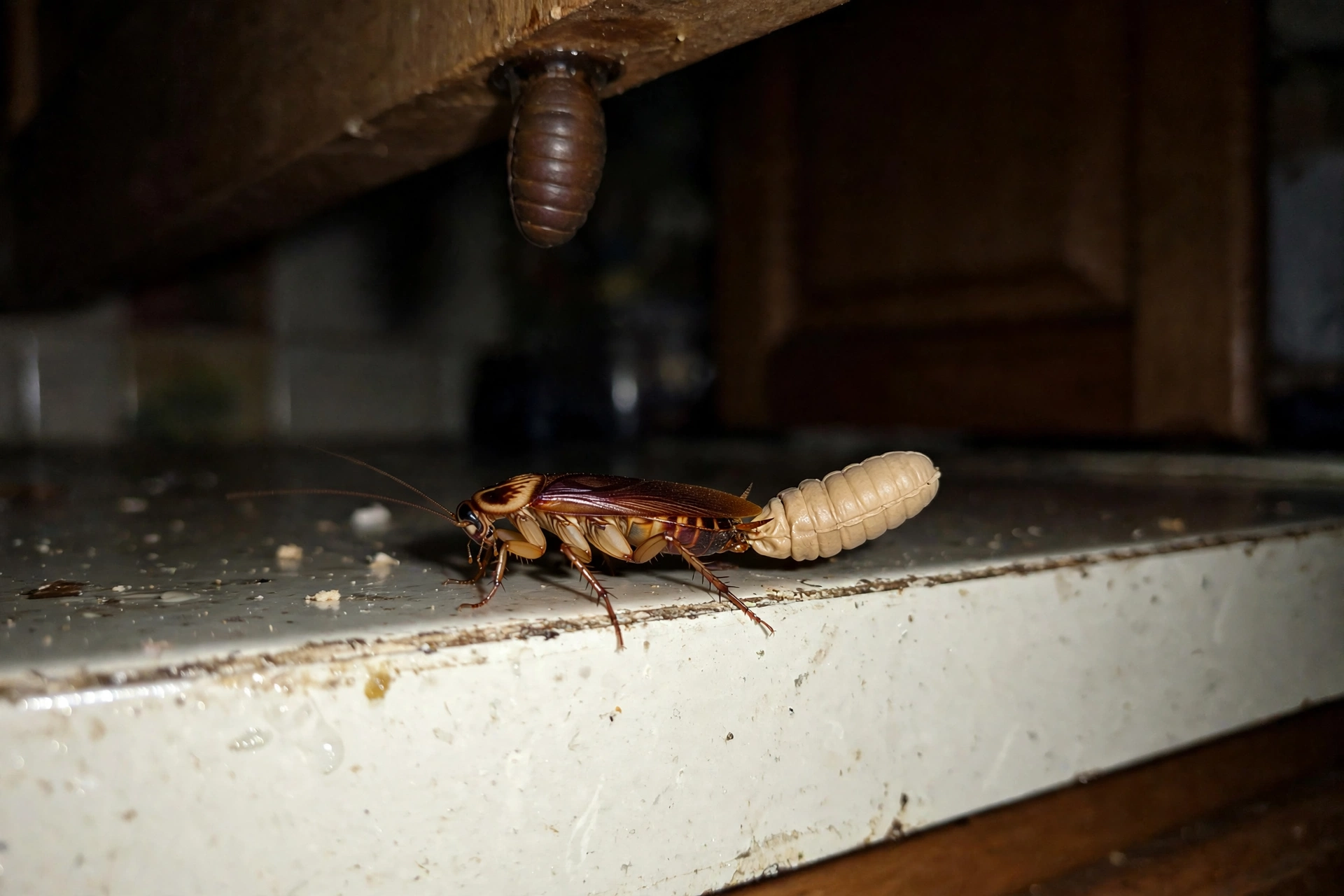
Above all, a flashlight and patience beat speed here. Cases are small, the color blends with wood and shadow, and the glued ones are usually on the underside of something. Pull drawers fully out, then check the underside of every shelf lip.
Not an Egg Case? The Confusers
Droppings. In contrast, the most common mix-up, and it runs both ways: homeowners photograph black specks asking if they are eggs, and photograph cases asking if they are droppings. Droppings are loose evidence, pellets, specks and smears; an egg case, in contrast, is a single solid capsule with a smooth surface and a definite purse shape. If your find is a scatter rather than one object, work through our guide to cockroach droppings vs mouse droppings instead, size, ends and ridges settle it.
A hatched, empty case. After hatching, the case remains, lighter, drier, sometimes split along the top seam. An empty case is history, not a countdown. Nevertheless, it is still evidence: something hatched here, and the female who left it usually leaves more.
Seeds and grit. Similarly, plant seeds, mouse-hoard crumbs and bits of gravel get posted to pest forums as “eggs” constantly. Seeds have a seam and a point of their own and no uniformity; a roach case is strikingly regular, same shape, same size, smooth hardened shell. When several identical capsules appear in one harborage, that regularity is, in fact, the tell.
Bed bug eggs. Much smaller, in fact, at about 1 mm and pearl-white, they sit in mattress seams and furniture joints rather than kitchen harborages. If what you found is white and pinhead-sized around a bed or sofa, it is a different problem with a different response; this guide, however, does not cover it.
What One Case Actually Means
Homeowners, however, tend to read a single case as a small problem, one capsule, dealt with, done. The biology runs the other way. Instead, a case means a mature female is, or very recently was, living within a few feet of where you found it. She does not, moreover, produce just one case. The numbers below are why professionals treat a found case as the start of the work, not the end of it:
UC IPM adds the multiplier: a German female produces a new egg case every few weeks across her life. Meanwhile, the cases you never find, behind appliances, inside wall voids, under drawer runners, are on the same schedule as the one you did find. In other words, one case in the open almost always means more cases in the dark.
Found One? What to Do
- Photograph it in place, with a dime beside it. Species identification, after all, turns on size and color, and a scaled photo lets a provider identify it without a visit. Afterwards, note the room and the exact spot.
- Remove it, carefully. Scrape glued cases up with a putty knife; pick loose ones up with a tissue or glove. Crush the case or drop it into hot soapy water, then take it out of the house in a sealed bag. Otherwise, a live case thrown in the kitchen bin is a case that hatches in the kitchen bin.
- Vacuum the harborage. Extension guidance is consistent on this point. Vacuuming, in fact, physically removes cases, nymphs and the debris that shelters them, and it reaches into the cracks sprays cannot. Then empty the vacuum outside.
- Do not rely on a spray or a fogger. This, however, is the point homeowners most often get wrong. UC IPM is blunt that sprays do not penetrate into the cracks and crevices where cockroaches live and “insecticide sprays alone will not eliminate cockroaches”; NC State Extension, moreover, adds that foggers fail for exactly the same reason, they never reach the hidden places where the roaches and their egg cases are. In other words, the case you can see is not the reservoir; the hidden harborage is.
- Set sticky traps where you found it. UC IPM recommends traps for monitoring and identification: the traps then confirm the species, show whether nymphs are emerging, and tell you whether the problem is shrinking or growing over the following month.
- Fix the welcome mat. Seal the gaps around pipes and cables, repair drips, and clear the grease and cardboard that feed a harborage. Finally, no treatment outruns a kitchen that keeps offering food, water and shelter.
When It Stops Being a DIY Job
One American case in a basement is a cleaning job. Cases in more than one room, a German case anywhere, live roaches in daylight, or nymphs appearing after you have cleaned, that is an established breeding population, and it is the pattern baits, growth regulators and harborage treatment exist for. Our cockroach extermination services guide explains what a proper program involves. Or call to check availability with an independent local provider, bring the photo; the species decides the treatment. The line is answered 24/7.
Call (844) 434-2186PestControlServicesNearby.com is a connection service that links homeowners with independent local pest control providers. We are not the treating company, we do not set their prices, and availability varies by area.

The identification threads, in fact, follow a ritual: a close-up photo, a coin or fingertip for scale, and a yes-or-no verdict in the replies. Still, three patterns repeat often enough to be useful. First, context decides, a case found in a kitchen at night, in a home already seeing German roaches, is read very differently from the same object in a garage. Second, co-signs decide: several threads start as “eggs?” and end as droppings once other commenters ask about tiny black specks nearby, pellets and specks mean droppings, a single solid purse means a case. Third, the finds cluster where this guide says to look: one recent thread is a case found in bathroom trash among tissues, and several turn on a female photographed with the case still attached plus a new nymph nearby: the carried-case behavior, caught on camera.
The lesson: photograph the object in place with scale, and photograph what is around it. In short, location and company are half the identification.
Community posts are homeowner anecdotes. The identification figures in this guide come, instead, from the university extension sources listed below.
Common Mistakes
| Mistake | Why it backfires | Do this instead |
|---|---|---|
| Throwing a live case in the indoor trash | The countdown, however, keeps running in the bin: German cases can hatch within days of being dropped. | Crush it or use hot soapy water, then bag it and put it outside. |
| Spraying the case and stopping there | Sprays and foggers never reach the hidden harborages where cases actually sit (UC IPM; NC State Extension). | Instead, remove cases physically, vacuum harborages, and use traps to monitor. |
| Crushing a case underfoot indoors | Crushing works. On a kitchen floor, however, you risk tracking fragments and missing the harborage it came from. | Scrape, crush into a tissue or soapy water, then clean and inspect the spot it came from. |
| Treating one case as the whole problem | Females produce a new case every few weeks, so the found case is the visible one, not the only one. | Search the harborages listed above and set monitoring traps for a month. |
| Assuming every case is a German case | Species changes everything: placement, hatch window and where else to search. | Instead, run the size, color and placement checks before you act. |
| Waiting to “see if more appear” | With a 28 to 30 day German hatch cycle, one month of waiting is therefore one full generation. | Act the day you find it; after all, the countdown is already running. |
Questions Homeowners Ask
What do cockroach eggs look like?
Cockroach eggs are not visible individually; instead, they come packed in a hardened, purse-shaped case called an ootheca. German cases are light beige and about 1/4 inch long; American cases are about 3/8 inch and turn from brown to black within a day or two; brown-banded cases are small and light brown; Oriental cases are about 3/8 inch and dark red-brown. Above all, the smooth, regular capsule shape is the giveaway.
How do I identify a cockroach egg?
Run four checks: shape (a smooth, hardened purse- or bean-shaped capsule, not a pellet or a speck), size against a dime (about 1/4 inch for German and brown-banded, about 3/8 inch for American, Oriental and smokybrown), color (light beige points to German; a case turning black points to American), and placement (carried by a female, glued to a surface, or dropped near food). Finally, the comparison table above walks through each species.
How long do cockroach eggs take to hatch?
It depends on the species and, notably, on the temperature. German cockroach eggs hatch in about 28 to 30 days, and the female carries the case for almost all of that time. American cases take about 6 to 8 weeks, sometimes 2 months or more. Brown-banded cases take 37 to 103 days depending on temperature, and Oriental cases about 42 to 81 days. Warmth, in fact, shortens every window.
Can you visibly see roach eggs?
You cannot see individual eggs, since they are sealed inside the case. You can, however, absolutely see the case itself. At 1/4 to 3/8 of an inch it is roughly the size of a grain of rice to a small bean, and it sits in plain sight once you know to check hinge voids, drawer undersides, appliance motors and the underside of the sink. A flashlight, therefore, helps: the cases blend into wood tones.
What to do if I see cockroach eggs?
Photograph the case in place with a coin for scale, then remove it: scrape it up, crush it or drop it in hot soapy water, and take it outside in a sealed bag. Vacuum the surrounding harborage, set sticky traps where you found it, and, finally, search the matching harborages for more cases. If you find cases in more than one room, or the case is German, then treat it as an established infestation and get the species professionally identified.
Should you destroy roach eggs?
Yes, an intact case left alone is a dozen or more roaches on a timer, so destroying cases you find removes whole broods before they start. Crush the case or immerse it in hot soapy water, and dispose of it outside the home. Do not, however, just move it or bin it intact indoors: a German case dropped shortly before hatching can still hatch in the trash.
Are cockroach eggs sticky?
Some, however, are fixed in place and some are not. Brown-banded females glue their cases to ceilings, furniture undersides and closet walls, and American females cement theirs to a protected surface after carrying it for about 6 days. Oriental cases are simply dropped, not glued. German cases are different again: the female carries the case on her body until 1 to 2 days before it hatches, so nothing about it is stuck down at all.
Does bug spray kill cockroach eggs?
Spraying is, in fact, the weakest tool for this job. UC IPM states that insecticide sprays do not penetrate into the cracks and crevices where cockroaches live, and that sprays alone will not eliminate cockroaches; NC State Extension notes foggers fail to reach the hidden areas where roaches and their egg cases sit. The reliable way, instead, is physical: remove it, crush it, vacuum the harborage, and monitor with traps.
Final Takeaway
A cockroach egg case is the most honest evidence an infestation leaves: solid, identifiable, and stamped with a species and a hatch date. So identify it by size, color and how it was placed; respect the countdown, about a month for German cases, up to two months or more for the larger species; remove every case you find and vacuum the harborages behind it. Above all, do not mistake a sprayed surface for a solved problem. Once you find a second case, or one German case, the job has already outgrown DIY, that is the moment the species, not the spray, should decide what happens next.
Get the Case Identified, and the Harborage Behind It Treated
A photo of the case, with a coin beside it, is enough for a provider to name the species and, consequently, quote the right program. Call to check availability with an independent local provider in your area.
Call (844) 434-2186PestControlServicesNearby.com is a free connection service that links homeowners with independent local pest control providers. We are not a pest control company, we do not perform treatments, we do not set provider prices, and we cannot guarantee availability, outcomes or appointment timing. Providers are independent businesses responsible for their own work, licensing and insurance.
Research Sources and Editorial Transparency
Every identification figure in this guide, case sizes, colors, eggs per case, hatch times and carrying behavior, comes from a university extension or government source, checked at the time of writing:
- UC IPM, Cockroaches Pest Notes, case descriptions and sizes for all five species, German carrying behavior and the 30,000-offspring figure, spray limitations, trap monitoring.
- UF/IFAS, German Cockroach (EENY-002), case dimensions, 30 to 40 eggs, 20 to 30 day incubation.
- Penn State Extension, Brown-banded Cockroaches, about 13 eggs per case, 37 to 103 day egg stage, gluing behavior.
- UF/IFAS, American Cockroach (EENY141), 8 mm case, brown-to-black color change, incubation of about 50 days.
- NC State Extension, German Cockroach Surveillance and Management, fogger and spray limitations, monitoring practice.
- UF/IFAS, Oriental Cockroach (EENY159), 16 eggs per case, 42 to 81 day incubation, carrying period of 12 hours to 5 days.
- Penn State Extension, Oriental Cockroaches, 16 eggs per case, about 60 days to hatch at room temperature, dropped not glued.
- Oklahoma State University Extension, Smokybrown Cockroach: the alternative smokybrown figures noted in the table.
This guide was researched and written by the PestControlServicesNearby.com editorial team. We are a connection service, not a pest control operator, so we do not claim field experience we do not have, and where extension sources disagree, as they do on smokybrown numbers, we show both figures instead of choosing silently. Community patterns, likewise, are labeled as anecdotes wherever they appear.
Service Disclaimer: PestControlServicesNearby.com is a free service to assist homeowners in connecting with local service providers. All contractors/providers are independent and PestControlServicesNearby.com does not warrant or guarantee any work performed. It is the responsibility of the homeowner to verify that the hired contractor furnishes the necessary license and insurance required for the work being performed. All persons depicted in a photo or video are actors or models and not contractors listed on PestControlServicesNearby.com.
Same-day and 24/7 emergency services are subject to provider participation, location, technician availability, and demand. Availability is not guaranteed and may vary by market and appointment capacity.