You notice a narrow, brown, dirt-like line running up the brick wall or concrete foundation of your Plano home. Is it soil, a trail from ants, or evidence of subterranean termites? Before cleaning it away, examine what you have found.
Termite mud tubes are enclosed, earth-like passages built by subterranean termites to travel while limiting exposure to dry air. They may appear along foundations, brick, concrete, wood, and other surfaces.
However, a suspicious mud structure does not automatically establish current termite activity or the extent of damage. Photograph the material, preserve useful evidence, and obtain qualified identification when appropriate.
For Plano homeowners, identifying these structures correctly matters. In particular, ants, mud-dauber wasps, and even construction materials can leave evidence that looks confusingly similar.
This guide explains what termite shelter tubes look like, where they commonly appear, how to distinguish lookalikes, and what to do next. Additionally, it addresses real questions raised by homeowners in Texas and elsewhere.
Call to inquire about independent pest-control providers who may be able to help evaluate your termite concern.
Independent-provider connection service. Local coverage, services, and appointment availability vary and are not guaranteed.
Why Correct Identification Matters: Official Termite Statistics
Termites can cause significant economic damage when colonies invade buildings. Nevertheless, the presence of a brown mud-like structure does not mean a homeowner automatically faces an expensive infestation.
These published figures show the broader importance of termite awareness. Importantly, neither is a Plano-specific estimate.
Source: Texas A&M AgriLife Extension, Subterranean Termites (2025).
Source: U.S. Environmental Protection Agency.
Data context: The Texas statistic estimates statewide subterranean-termite damage, while the EPA statistic concerns nationwide termite treatment spending. They measure different things and should not be added together or used to estimate an individual home’s costs.
According to Texas A&M AgriLife Extension, subterranean termites occur throughout Texas. Furthermore, their activity can remain concealed behind wall coverings, siding, and trim. Therefore, learning to recognize shelter tubes is useful, although visible evidence never tells the whole story.
What Do Termite Mud Tubes Look Like?
Termite mud tubes often resemble narrow, rough trails of dried or compacted earth. Many are approximately pencil-width, although size and shape vary. They may extend vertically, travel across masonry, or branch along a surface.
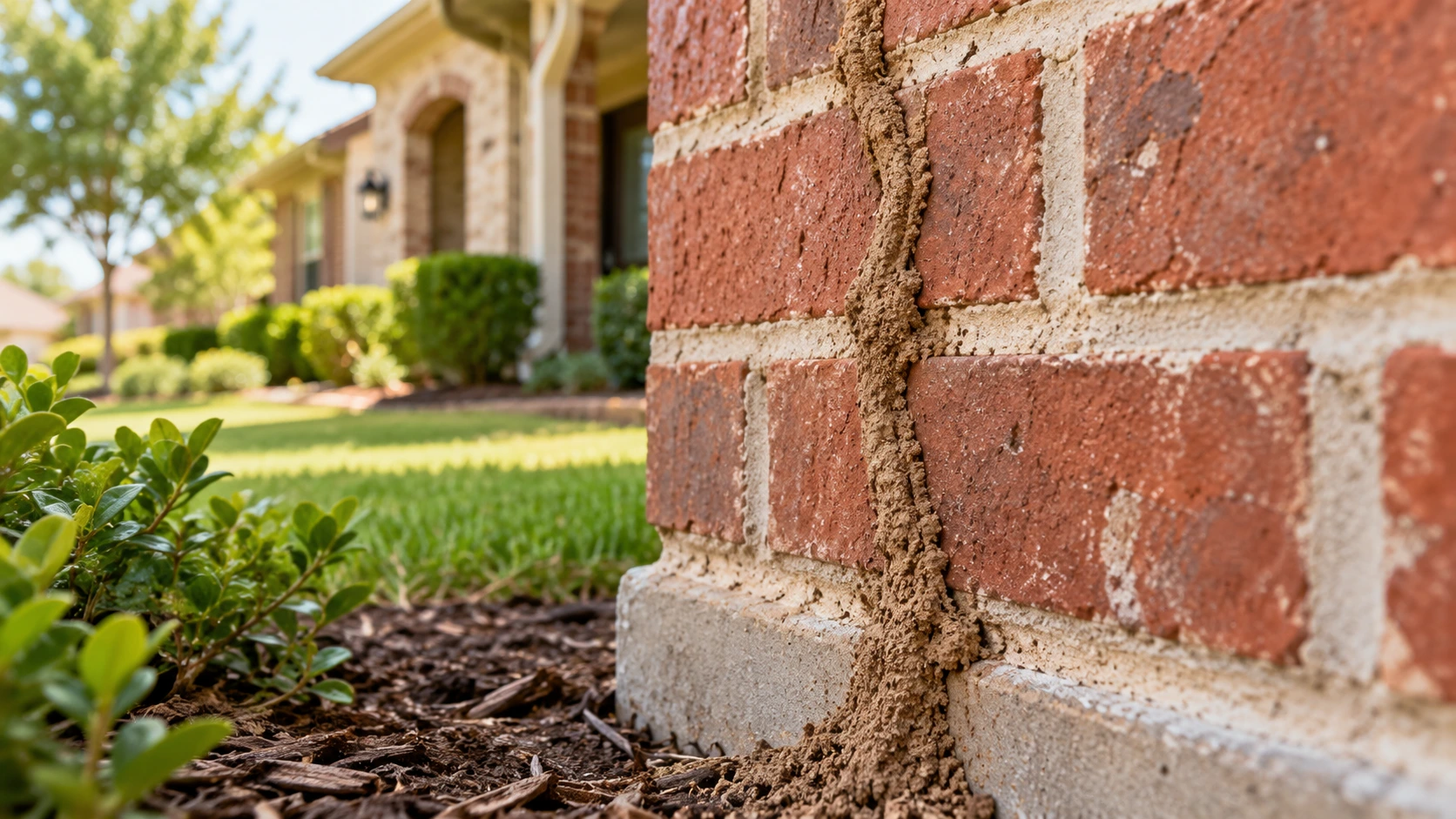
Four characteristics to examine
Earth-like texture
The surface often resembles gritty or unevenly packed soil. Consequently, it usually looks different from a flat stain or painted line.
Enclosed passage
The structure forms a physical tunnel rather than just a visible line of insects moving across an uncovered surface.
Continuous or branching route
A suspected tube may climb a wall, run along a foundation, or branch toward another building component. However, part of the route may remain hidden.
Connection to structural surfaces
Tubes may cross concrete, brick, wood, joints, or cracks. Nevertheless, no single location proves the identity of the material.
Why do termites build shelter tubes?
Subterranean termites usually forage through soil, wood, or protected spaces. However, they sometimes need to cross exposed surfaces to reach suitable food. Shelter tubes provide a more protected travel route.
For example, a termite tube on concrete does not mean termites are eating the concrete. Instead, the structure may help them cross masonry toward a wooden component.
Are there different kinds of termite tubes?
Yes. Termite specialists recognize working or utility tubes, exploratory tubes, and drop tubes. Their shape and function vary. In addition, some termite-built structures are associated with swarming activity.
However, homeowners should avoid identifying a termite species from the tube type alone. A qualified inspection may be needed to establish what produced a structure.
Where to Find Termite Mud Tubes Around a Plano House
Termite mud tubes may appear in several accessible areas. Therefore, when you spot a suspicious structure, note both its location and the surrounding construction.
The following original illustration highlights six useful observation points around a brick-and-slab home.

Termite tubes on concrete foundations
Exposed slab edges and foundation walls are common locations for visible shelter tubes. For instance, a tube may extend upward from the soil or travel across concrete toward an opening.
Consequently, a wide photograph showing the foundation is often more informative than a close-up of the dirt-like material alone.
Termite mud tubes on brick
Brick walls and mortar joints can provide surfaces for termite travel. However, other insects may also attach mud-like structures to masonry.
Therefore, look at whether the material forms a continuous passage, separate mud cells, or loose deposits before assuming the cause.
Termite mud tubes inside the house
Suspected shelter tubes can occur around accessible interior foundation walls, baseboards, garages, and utility areas. Moreover, termites may travel through concealed spaces before visible evidence appears.
If suspicious material emerges from a finished wall, photograph it. Avoid removing drywall or structural components yourself simply to trace its path.
Termite mud tubes hanging from a ceiling
Some termite-built shelter structures may extend downward from elevated wood or other overhead areas. However, appearance and location alone cannot establish whether the material was made by termites or identify a particular species.
Accordingly, overhead findings deserve careful evaluation rather than an assumption about infestation severity.
Termite mud tubes in the yard
Subterranean termites naturally occur in soil and can be associated with buried wood, stumps, or landscaping materials. Nevertheless, outdoor termite activity does not automatically prove that the house itself is infested.
The relationship to nearby buildings and any additional evidence matters. As a result, a property-specific inspection may be needed to interpret the finding.
A qualified professional can help identify suspicious termite evidence and explain whether an inspection is appropriate.
Termite Mud Tubes vs. Ant Trails and Other Lookalikes
One of the clearest findings from our Reddit homeowner research is that people often confuse termite evidence with other materials. In particular, ant-related soil deposits and mud-dauber nests can cause unnecessary alarm.
Therefore, the most helpful comparison examines the structure, not simply its color.
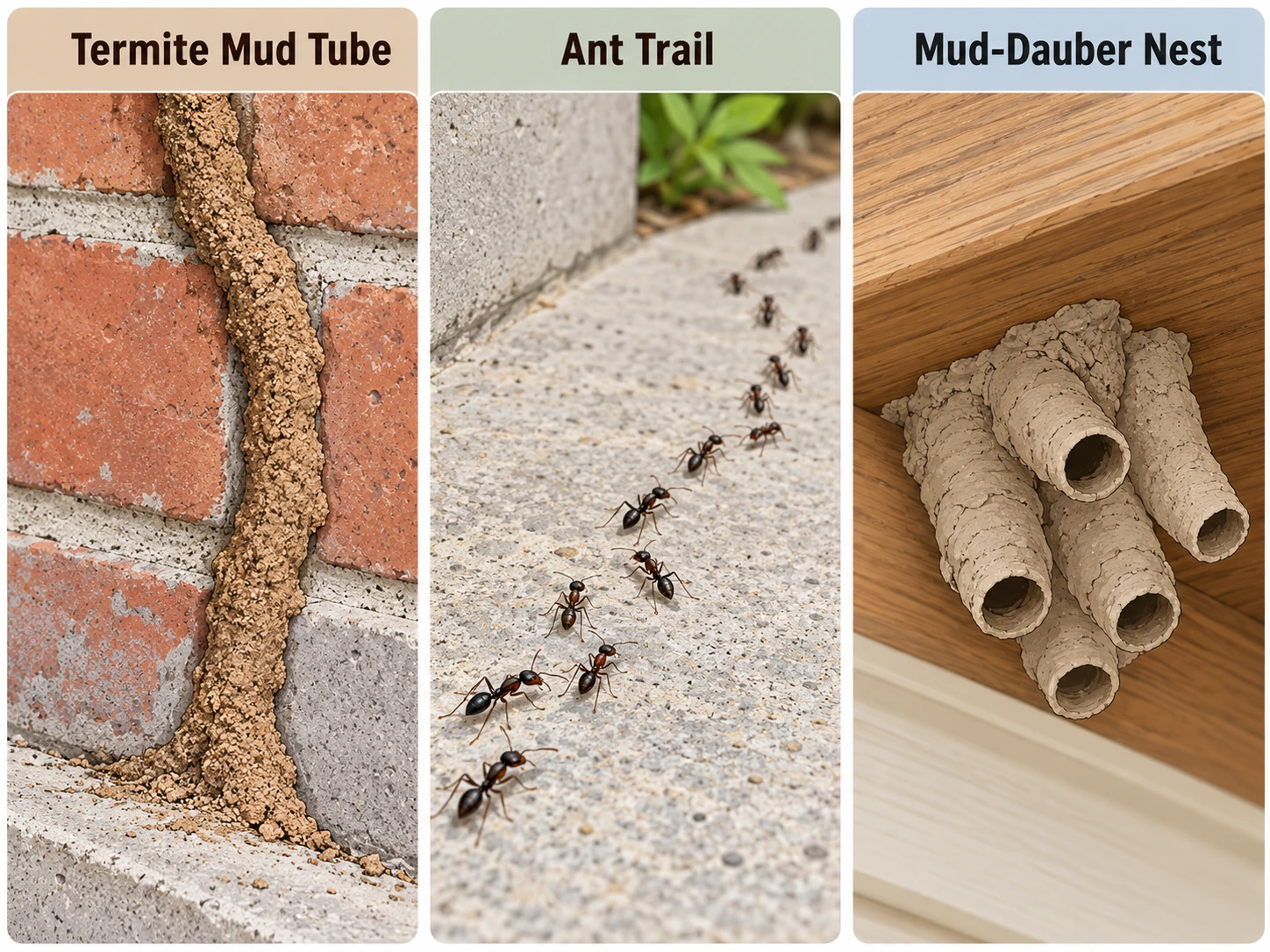
Termite mud tubes vs. ant trails
Ants often follow exposed routes that may be visible as lines of moving insects. By contrast, subterranean termites construct enclosed earthen shelter tubes that can remain even when insects are not visible.
However, ants may excavate or move soil and can sometimes create covered routes. Therefore, a pile of dirt alone does not distinguish the two.
| Feature | Possible termite shelter tube | Ordinary exposed ant trail |
|---|---|---|
| Appearance | Raised, enclosed, earth-like passage | Ants moving along an uncovered route |
| Structure left behind | Physical tube may remain on a surface | Usually no continuous shelter tube, although soil deposits may occur |
| Visible insects | Termites may remain concealed | Individual ants are often visible |
| Identification limit | Other mud structures may resemble tubes | Ants can produce soil deposits or covered passages |
| Next step | Photograph and investigate the suspected tube | Identify the ants and source of activity |
Termite mud tubes vs. mud-dauber nests
Mud-dauber wasps build nests from mud, commonly attaching them to protected surfaces. Depending on the species, the nests may contain elongated cells or groups of cells.
By comparison, subterranean termite shelter tubes primarily function as protected travel routes. Still, some mud structures can look alike in photographs, so identifying the entire structure matters.
Can construction materials resemble termite tubes?
Yes. Mortar residue, construction adhesive, deteriorating finishes, and soil deposits may all produce confusing marks around a building.
As a result, homeowners should document the surrounding surfaces and look for additional evidence before drawing conclusions. Color alone is not enough.
Quick Identification Guide: Is It Really a Termite Mud Tube?
When you discover suspicious material, the following questions can help organize your observations. However, this process is educational and cannot replace identification by a qualified professional.
If yes, a termite shelter tube is possible. If not, the finding may involve loose soil, ants, mud-dauber cells, or another material.
A passage crossing masonry, foundations, joints, or wood may justify further termite investigation. Nevertheless, the location alone cannot identify the pest.
Record insects, discarded wings, damaged wood, moisture, or recurring deposits. However, none of these observations should be interpreted without context.
If so, photograph the material, preserve evidence, and ask about qualified pest identification rather than selecting a treatment based on appearance alone.
This decision guide cannot confirm an infestation, identify termite species, or establish structural damage.
Don’t choose treatment from an online picture alone. Call to inquire about independent pest-control providers serving Plano-area homeowners.
Do Termite Mud Tubes Mean an Active Infestation?
A correctly identified shelter tube indicates that termites constructed it at some point. However, the visible structure does not necessarily establish whether the colony remains active at the time of discovery.
Mississippi State University Extension explains that observing termites inside a tube or seeing a damaged section repaired can demonstrate activity. Nevertheless, failure to observe those signs does not conclusively rule out termites elsewhere in the structure.
Are dry termite mud tubes inactive?
Not necessarily. Older tubes may become dry or brittle, but dryness alone is not a reliable test of whether termites have left the property.
Furthermore, termites may travel through other routes that remain concealed. Consequently, a dry tube should not create false reassurance.
Should homeowners break termite mud tubes?
A qualified inspector may open a small section of a suspected shelter tube to examine it. However, homeowners should photograph the material before disturbing it and preserve useful evidence.
Removing the visible tube does not destroy an underground termite colony. Therefore, scraping it off the wall is not an effective termite treatment.
What if a mud tube returns after removal?
Freshly constructed material may indicate ongoing insect activity. Nevertheless, the observation does not establish which insect created it.
Record the dates and photograph the change. Then, if the evidence is concerning, seek proper identification.
Can a house have termites without visible mud tubes?
Yes. Subterranean termites may move through concealed cracks, joints, or building components. As a result, homeowners may see no obvious exterior tubes even when activity is present somewhere inside the structure.
Other clues can include swarmers, discarded wings, or damaged wood. For a broader explanation of inspection findings, see our termite inspection guide.
What Should You Do If You Find Termite Mud Tubes?
Finding a suspicious tube can be stressful. However, organized documentation is more useful than immediately scraping away the material or attempting treatment without identification.
- Photograph the full location. Capture the wall, foundation, garage, or room so the surroundings are visible.
- Take a close-up. Record the texture and approximate width. If possible, place a ruler nearby without touching or breaking the material.
- Document the visible route. Note where the structure begins, branches, and disappears. Do not remove building finishes to trace it.
- Observe related evidence. Record visible insects, discarded wings, damaged wood, or moisture. However, avoid making a diagnosis from one clue.
- Review earlier records. Previous termite inspection reports, treatments, or warranties may help an inspector understand the property’s history.
- Ask for qualified identification. A provider can explain what the evidence indicates, which areas were inspected, and whether further action is appropriate.
Four Photos to Capture Before an Inspection
Show the full wall, foundation, or room.
Capture the surface texture and size reference.
Document the start, end, and branches.
Include adjacent wood, cracks, insects, or moisture.
Concerned About Possible Termite Activity in Plano?
You’ve identified and documented something suspicious. The next step may be a qualified inspection. Call to inquire about connecting with an independent pest-control provider in a participating service area.
Call (844) 434-2186PestControlServicesNearby.com connects homeowners with independent pest-control providers. It does not directly inspect or treat homes. Available services, coverage, pricing, and appointments vary by provider and are not guaranteed.
Plano Homeowner Checklist: Moisture and Possible Entry Conditions
In addition to identifying suspected mud tubes, homeowners can observe conditions that may influence termite access. The U.S. EPA recommends maintaining drainage, addressing leaks, reducing access openings, and avoiding unnecessary wood debris beside structures.
Foundation and slab edges
Observe accessible cracks, joints, exposed edges, and suspicious structures along the foundation.
Moisture and irrigation
Check for plumbing leaks, wet soil, drainage problems, and irrigation that repeatedly wets the building perimeter.
Wood-to-soil contact
Note timber, firewood, or other wooden materials touching soil close to the structure.
Utility penetrations
Observe accessible gaps around plumbing or other utility openings without disturbing electrical or structural installations.
These are useful observations, not proof of termites. Moreover, Plano houses differ in age, construction, maintenance, and previous termite-protection history.
What Should a Texas Termite Inspector Explain?
A useful termite inspection should communicate the evidence rather than simply recommend treatment. Therefore, homeowners should understand the identification, visible findings, and inspection limitations.
Five important questions to ask
- What evidence identifies termites? Ask whether live termites, shelter tubes, swarmers, or damaged wood were observed.
- Is activity currently visible? Ask what supports a conclusion of active, past, or uncertain infestation.
- What areas could not be inspected? Finished walls, blocked areas, and concealed spaces can limit what is known.
- Why is this treatment being recommended? Ask how the proposal addresses the identified problem and property conditions.
- What written documentation will I receive? Ask about findings, treatment scope, follow-up, and applicable service warranties.
What is the Texas Wood Destroying Insect Report?
The Texas Department of Agriculture provides instructions for the official Wood Destroying Insect Report, Form SPCS/T-5. The report distinguishes observations of active infestation, evidence of previous infestation, and visible signs of past treatment.
Importantly, evidence of a prior treatment does not establish that it was completed successfully. Additionally, the inspection report describes what was observed within the scope of the inspection.
Not every ordinary pest-control consultation uses the same report format as a qualifying official WDI inspection.
For more detail, visit our termite inspection resource. If subterranean termites are confirmed, our subterranean termite treatment guide discusses professional management options.
Five Common Mistakes About Termite Mud Tubes
Homeowners sometimes draw conclusions that the visible evidence cannot support. Therefore, keep these distinctions in mind before deciding what to do.
| Common assumption | More accurate explanation |
|---|---|
| The tube is dry, so termites are gone. | Dryness alone cannot establish that the property is free from current termite activity. |
| I removed the tube, so the problem is solved. | Removing a visible shelter tube does not eliminate an underground termite colony. |
| Every brown mud structure means termites. | Ant activity, mud-dauber nests, and building materials can produce confusing lookalikes. |
| One tube means the entire house is damaged. | A visible tube does not establish the extent of any concealed damage. |
| No exterior tubes means no termites. | Some termite entry routes and activity remain hidden. |
Frequently Asked Questions About Termite Mud Tubes
What do mud tubes look like for termites?
They often resemble narrow, raised, earth-colored tunnels running along foundations, brick, concrete, or wood. Nevertheless, the appearance varies, and some other materials look similar.
Should you destroy termite mud tubes?
Photograph and preserve useful evidence before disturbing it. Inspectors may open a small section for evaluation, but removing the visible tube does not eliminate termites.
How fast can termites build mud tubes?
Construction and repair depend on colony activity and environmental conditions. Therefore, no single number of hours or days reliably establishes whether termites are present or absent.
How do I treat termite mud tubes in my home?
First, establish whether the material is associated with termites. Effective treatment addresses the termite infestation and relevant access conditions rather than simply removing a visible tube. A qualified provider can explain available approaches.
Can termite mud tubes appear on brick or concrete?
Yes. Subterranean termites can build shelter tubes across masonry while traveling toward wood or concealed spaces. However, the masonry itself is not termite food.
Can termite mud tubes appear inside the house?
Yes. Suspected tubes may appear around interior foundations, utility areas, baseboards, or other accessible structural features. Furthermore, additional routes may be concealed.
Are termite mud tubes inside a house dangerous?
They can indicate a potential termite concern, but the tube alone cannot determine the extent of structural damage. Accordingly, proper identification and inspection are important.
Do dry termite mud tubes mean the infestation is over?
No. Old tubes can remain after activity ends, but their appearance alone does not rule out current termites elsewhere in the property.
Can a newly built Plano home have termites?
Yes. New construction does not eliminate termite risk. Preventive treatment history, construction details, moisture, and possible entry conditions can all matter.
Can termites be present without visible mud tubes?
Yes. Termites may enter or move through concealed locations. Consequently, the absence of visible exterior tubes does not prove a house is termite-free.
How can I distinguish a termite tube from an ant trail?
A typical ant trail involves ants moving along an exposed route, whereas subterranean termite shelter tubes form enclosed earthen passages. However, ants can also move soil or create covered routes, so identification may require more evidence.
Final Takeaway: Identify the Structure Before Choosing Treatment
Termite mud tubes deserve attention when correctly identified. However, one visible structure cannot establish the full condition of a home.
Instead, begin with clear photographs, examine accessible surrounding evidence, and compare the structure with common lookalikes. Moreover, avoid assuming that a dry tube proves inactivity or that every mud-like deposit belongs to termites.
When the evidence remains suspicious, a qualified inspection can help clarify the next step. For other local pest concerns, explore our Plano pest control services page.
Need Help With Possible Termite Mud Tubes in Plano, TX?
Have you found suspicious material on your foundation, brick wall, or inside your home? Call to inquire about connecting with independent pest-control providers serving participating Plano-area locations.
Call (844) 434-2186PestControlServicesNearby.com is a homeowner-to-independent-provider connection website, not the company directly performing inspections or treatments. Participating providers determine coverage, available services, pricing, appointment capacity, and recommendations. Availability is not guaranteed.
Research Sources and Editorial Transparency
This article uses government and university extension resources for technical information. In addition, real homeowner Reddit discussions help illustrate common identification concerns. Those individual accounts do not constitute confirmed pest diagnoses.
- Texas A&M AgriLife Extension — Subterranean Termites (February 2025). Texas distribution, biology, structural concerns, and estimated statewide damage.
- U.S. Environmental Protection Agency — Termites: How to Identify and Control Them. National treatment spending, identification, prevention, and termite management guidance.
- Mississippi State University Extension — Signs of Termite Infestation. Shelter tubes, swarmers, damage, and interpretation of observed termite evidence.
- Texas Department of Agriculture — Texas Official Wood Destroying Insect Report Instructions (SPCS/T-5). Official report scope and classification of inspection findings.
Editorial disclosure: Original AI-generated article images are educational illustrations, not photographs of professionally identified termite infestations. Reddit cards summarize publicly shared homeowner accounts, and their reported outcomes have not been independently verified by PestControlServicesNearby.com. This guide provides general homeowner information, not a property-specific termite inspection or structural assessment. WordPress author information and any expert-review credit should reflect actual editorial responsibility and real reviews performed.
Service Disclaimer: PestControlServicesNearby.com is a free service to assist homeowners in connecting with local service providers. All contractors/providers are independent and PestControlServicesNearby.com does not warrant or guarantee any work performed. It is the responsibility of the homeowner to verify that the hired contractor furnishes the necessary license and insurance required for the work being performed. All persons depicted in a photo or video are actors or models and not contractors listed on PestControlServicesNearby.com.
Same-day and 24/7 emergency services are subject to provider participation, location, technician availability, and demand. Availability is not guaranteed and may vary by market and appointment capacity.