Most Seattle house spiders are completely harmless to humans and pets, with the Giant House Spider (Eratigena atrica) and Common House Spider (Parasteatoda tepidariorum) being the most frequent indoor sightings. The annual fall surge (September–October) is driven by mature males wandering indoors seeking mates. Brown recluse spiders do not live in Washington State.
Every September and October, homeowners across Seattle, Tacoma, and the Puget Sound region notice a sudden increase in indoor spider activity. Finding large, fast-moving arachnids in basements, bathtubs, or living rooms leads many residents to search for identification guides on seattle house spiders and whether local species pose any bite risks.
The vast majority of spiders found inside Pacific Northwest homes are beneficial insect hunters that help keep pest populations under control. However, understanding species differences, clearing common myths, and taking physical exclusion steps can keep your living space spider-free.
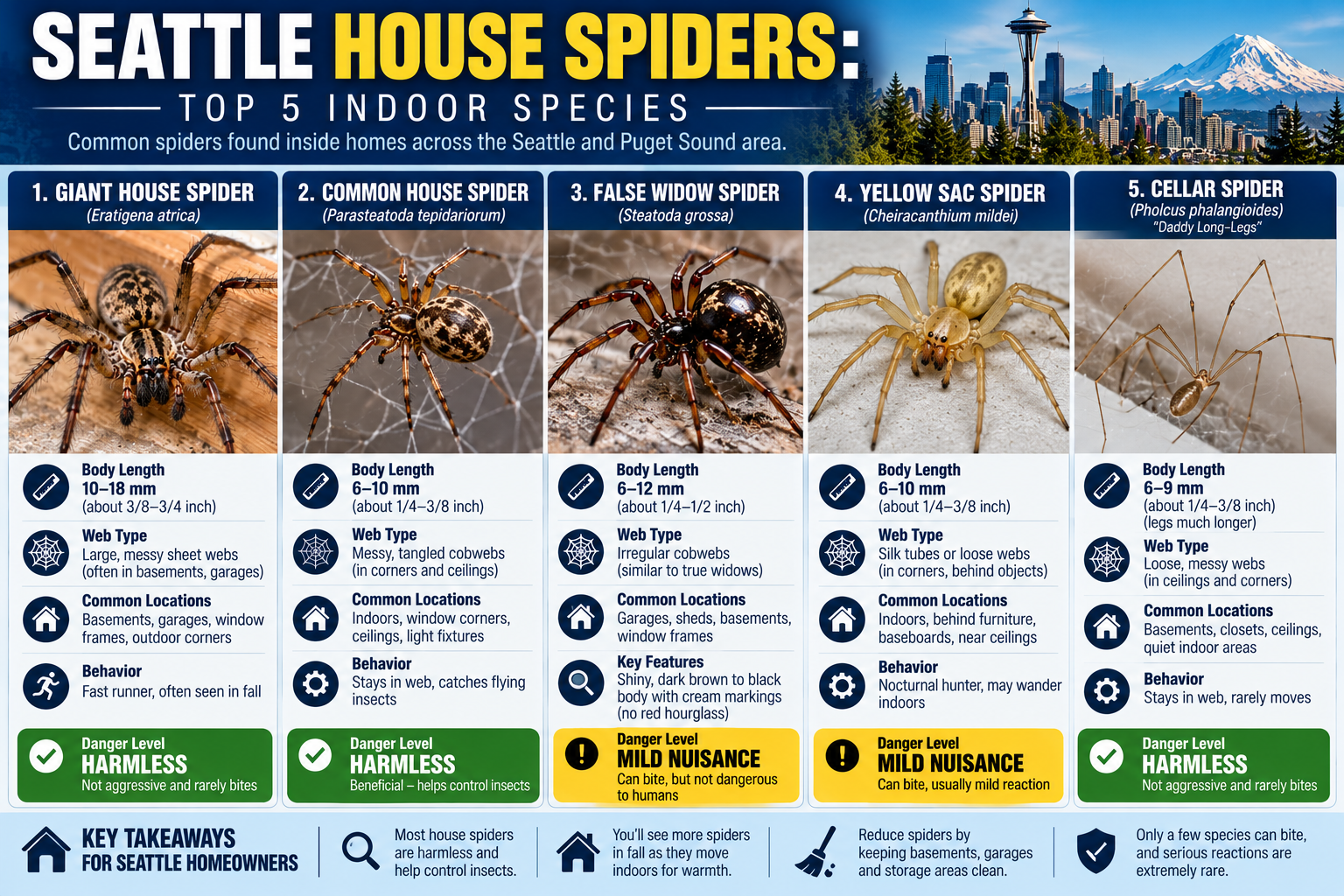
The Top 5 Common Seattle House Spiders
According to entomological research from Washington State authorities, five primary species account for nearly all indoor spider encounters around the I-5 corridor:
- 1. Giant House Spider (Eratigena atrica): Reaching a total leg span of up to 2 to 4 inches, this is the largest indoor spider in Seattle. Despite its intimidating size and rapid running speed, it is shy, non-aggressive, and rarely bites humans.
- 2. Common House Spider (Parasteatoda tepidariorum): Small (under 1/4 inch body length) with a mottled gray and tan globular abdomen. They construct tangled cobwebs in ceiling corners, window frames, and basement rafters.
- 3. False Black Widow (Steatoda grossa): Dark chocolate brown to purplish-black with a bulbous abdomen. Frequently mistaken for a venomous black widow, but lacks the red hourglass marking and delivers only mild, localized bite symptoms.
- 4. Yellow Sac Spider (Cheiracanthium spp.): Pale yellow to light tan. Rather than building webs, they spin small, flattened silk tubes along ceiling corners and wall junctions where they hide during the day.
- 5. Long-Bodied Cellar Spider (Pholcus phalangioides): Often called “daddy long-legs,” these thin, long-legged spiders hang upside down in loose basement webs and vibrate rapidly when disturbed.
To learn about the state’s only spider species of major medical concern and its regional distribution, read our full Washington State black widow spider guide.
Identification Comparison: Seattle Indoor Spiders
| Spider Species | Visual Appearance | Web / Nest Style | Danger / Bite Risk |
|---|---|---|---|
| Giant House Spider | Muted brown, long hairy legs, tan chevron thorax | Flat funnel web in corners | Harmless (Reluctant to bite) |
| Common House Spider | Small, mottled gray/tan globular abdomen | Tangled cobweb in high corners | Harmless nuisance |
| False Black Widow | Glossy chocolate brown / purplish-black | Irregular corner cobweb | Mild localized pain (Non-dangerous) |
| Yellow Sac Spider | Pale yellow/tan, dark claw tips | No web; silk sleeping tubes | Mild pinprick bite if squeezed |
| Cellar Spider | Extremely thin legs, pale translucent body | Loose basement webs | Harmless to humans |
Debunking Common Washington Spider Myths
Fear of indoor spiders is often fueled by common regional misconceptions. According to official Washington State Department of Health spider guidelines, two major facts clarify regional risks:
- Myth 1: “Brown Recluse Spiders live in Seattle basements.”
Fact: Brown Recluse spiders (Loxosceles reclusa) are not native to Washington State and do not have established populations in the Pacific Northwest. Most reported “recluse bites” are misdiagnosed bacterial skin infections or localized reactions to minor insect stings. - Myth 2: “Hobo Spider bites cause necrotic flesh wounds.”
Fact: Rigorous scientific and medical reviews have disproven the theory that Hobo Spider (Eratigena agrestis) venom causes necrotic skin lesions. Hobo spiders are shy, funnel-web builders that prefer outdoor window wells and woodpiles.
If you are evaluating other seasonal sting or bite hazards around your yard, see our yellow jacket vs hornet sting pain comparison.
⚠️ Bite First Aid & Medical Protocol
While Seattle house spider bites are rare and mild, any spider bite should be washed with soap and water. Apply a cold compress to reduce localized swelling. If symptoms include spreading redness, severe pain, muscle cramps, or if the bite recipient is a young child, older adult (over 65), or immunocompromised individual, consult a healthcare provider or call Poison Control at 1-800-222-1222.
How to Keep Spiders Out of Your Seattle Home
Because spiders walk on the tips of their tarsal claws, chemical sprays alone are often insufficient. Effective spider control relies on Integrated Pest Management (IPM) and physical exclusion:
- Seal Baseboards & Utility Lines: Apply silicone caulk along gap-prone baseboards, pipe penetrations, and crawl space vents.
- Vacuum Webs & Egg Sacs: Regularly vacuum behind furniture, in window wells, and under basement stairs to physically remove egg sacs and disrupt harborages.
- Reduce Outdoor Light Attractants: Replace white exterior porch lights with yellow LED bulbs, which attract fewer nocturnal flying insects that serve as spider prey.
- Eliminate Stored Clutter: Replace cardboard storage boxes in garages and attics with tight-sealing plastic bins to remove hiding spots.
Frequently Asked Questions
Why do house spiders suddenly appear in Seattle homes during fall?
The fall “spider surge” in September and October occurs because mature male spiders reach adulthood and actively wander indoors in search of female mates. They were already living in crawl spaces or wall voids throughout the summer.
Are giant house spiders dangerous to humans or pets?
No. Giant house spiders are harmless to humans and pets. Although their large size and fast movement can be alarming, they are non-aggressive and prefer to flee when disturbed.
Do brown recluse spiders live in Seattle?
No. Brown recluse spiders do not live in Washington State. Official health records from the WA Department of Health confirm there are no native brown recluse populations in Western Washington.