Fire ant mounds keep coming back because treating one visible mound does not permanently protect your yard. Nearby colonies can remain active, new queens can establish colonies, and fire ants can reinvade treated areas. Long-term control requires monitoring the entire property and using a treatment strategy suited to the infestation.
If fire ant mounds keep coming back after treatment, it does not necessarily mean the treatment failed. The new mound may belong to a different colony, or fire ants may have reinvaded the treated area.
This problem becomes especially frustrating when mounds repeatedly appear beside sidewalks, lawns, landscape beds, driveways, play areas, or places where children and pets spend time.
Texas A&M AgriLife Extension explains that no fire ant control method is permanent. Even successful treatment can be followed by reinvasion, which is why understanding the entire infestation matters more than repeatedly attacking whichever mound is visible today.
Fire Ant Mounds Keep Returning in Your Plano Yard?
If recurring fire ant activity is becoming difficult to manage, call to connect with an available residential pest-control provider serving the Plano area.
📞 Call to Connect: (844) 434-2186Why Fire Ant Mounds Keep Coming Back After Treatment
The mound you see above the lawn is evidence of a colony below the soil. Focusing only on that visible mound can make fire ant control frustrating because your property may contain several colonies at the same time.
According to Texas A&M’s fire ant management guidance, reinfestation can be influenced by factors such as the size of the treated area and the frequency of mating flights. This helps explain why new fire ant activity can appear even after an earlier mound was successfully treated.
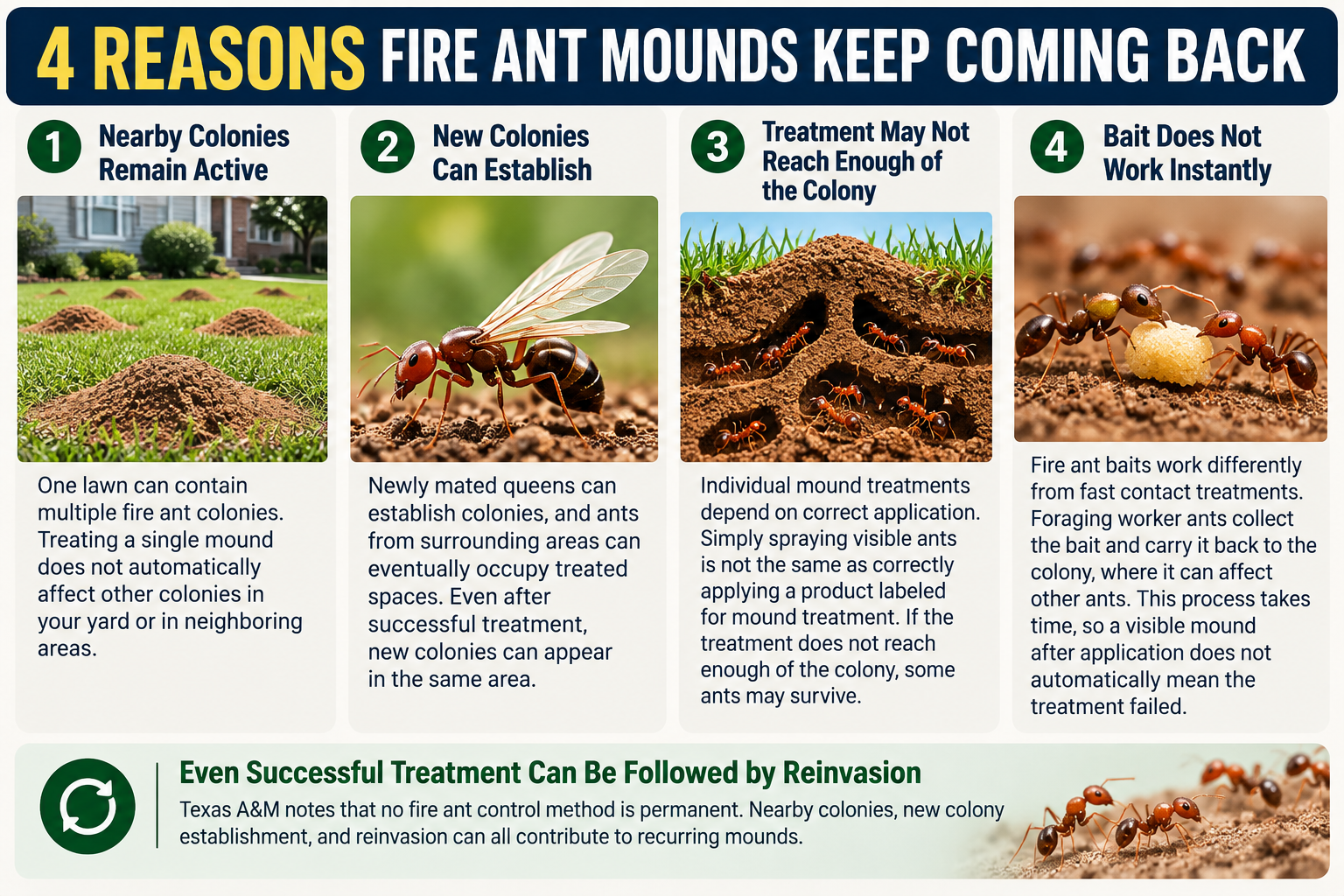
1. Nearby Colonies Were Never Treated
One lawn can contain multiple fire ant colonies. Treating a nuisance mound near a sidewalk does not automatically affect another colony elsewhere in the yard or ants occupying neighboring untreated areas.
This can create the impression that the same ants returned when you may actually be seeing activity from a different colony.
2. New Colonies Can Establish in Treated Areas
Fire ant control suppresses populations, but it does not permanently seal a property against future colonies. Newly mated queens can establish colonies, and ants from surrounding areas can eventually occupy treated spaces.
The size of the area being managed matters. Treating one mound or one small section of lawn does not control every colony in the surrounding environment.
3. The Treatment May Not Reach Enough of the Colony
Individual mound treatments depend on correct application. With contact insecticides, ants must encounter the treatment for it to work effectively.
Simply spraying visible worker ants on the surface is not the same as correctly applying a product labeled for mound treatment. Product directions may specify how much material to use, where to place it, and whether the mound should remain undisturbed.
4. Fire Ant Bait Does Not Work Instantly
Baits work differently from fast contact treatments. Foraging worker ants collect the bait and carry it back toward the colony, where the active ingredient can affect other ants.
That process takes time. A mound remaining visible shortly after bait application does not automatically mean the treatment failed.
Quick Check: Why Did Another Mound Appear?
- Same general area: A neighboring colony, surviving activity, or reinvasion may be involved.
- Several new mounds: Multiple colonies or newly established colonies may be present.
- Original mound disappeared: The treated colony may have been controlled, but another colony can still appear.
- Bait shows no immediate result: The treatment may still need time to affect the colony.
What Texas A&M Recommends for Recurring Fire Ants
When fire ant pressure extends beyond one or two isolated mounds, treating every mound separately can become inefficient.
For heavily infested turf, Texas A&M recommends its Two-Step Method for fire ant control, which combines an area-wide bait treatment with individual treatment of nuisance mounds.
Texas A&M describes this approach for fully infested areas with approximately five or more mounds per quarter-acre. Instead of reacting only to visible mounds, the strategy addresses the broader fire ant population while allowing problem colonies to receive additional attention.
Step 1: Apply a Labeled Broadcast Bait
The first step uses a fire ant bait labeled for broadcast application across the treatment area. Worker ants collect bait while foraging and carry it back into their colonies.
Application conditions matter. Texas A&M’s fire ant control guidance emphasizes choosing an appropriate labeled control method and following the product directions carefully.
With bait treatments, active foraging, bait condition, weather, timing, and correct application can influence how well the strategy works.
Step 2: Treat Problem Mounds Individually
The second step targets nuisance mounds that require additional attention between broadcast applications. Depending on the product and treatment site, labeled options can include mound baits, drenches, granules, or dust formulations.
This combination reduces reliance on repeatedly treating every visible mound while still allowing individual colonies in high-use areas to receive targeted attention.
If you are dealing with ants but are unsure whether fire ants are the only species involved, our ant control guide explains why ant identification and nesting behavior can affect the appropriate management approach.
⚠️ Always Follow the Pesticide Label
Before applying any fire ant product, read the entire label. The U.S. Environmental Protection Agency’s pesticide-label guidance explains that pesticide labels provide critical information about how products may be used, including directions, precautions, and restrictions.
Use only products labeled for the pest and treatment area involved. Follow all directions concerning application rates, weather conditions, protective equipment, storage, children, pets, and other precautions listed on the product label.
What to Do When Fire Ant Mounds Keep Coming Back
Recurring fire ants call for a property-level assessment rather than an endless cycle of reacting to whichever mound appeared most recently.
Use this process to understand the pattern before deciding on your next step.
- Check the entire yard for activity. Look for mounds around lawns, sidewalks, driveways, landscape beds, fences, play areas, utility areas, and other frequently used spaces. Avoid kicking or disturbing a mound simply to determine whether it is active.
- Count the visible mounds. One isolated colony presents a different management situation from numerous colonies spread across a lawn.
- Review what you treated previously. Determine whether you treated only individual mounds or used a labeled strategy intended to suppress fire ants across a wider area.
- Read the product label before applying anything. Confirm that the product is labeled for fire ants and for the specific treatment site. Follow the listed application rate, timing, precautions, and restrictions.
- Check whether ants are actively foraging before using bait. Fire ant bait depends on worker ants finding and collecting it. Poor timing can reduce bait pickup.
- Allow the treatment enough time to work. Do not assume a bait failed because the mound remains visible shortly after application. Different active ingredients and treatment methods work at different speeds.
- Monitor for new mounds. Successful treatment does not permanently prevent future reinvasion. Continue watching the property for renewed activity.
- Consider professional help for persistent or widespread activity. If mounds repeatedly appear across the property, a pest-control provider can assess the activity and discuss management options appropriate for the site.
Tired of Treating One Fire Ant Mound After Another?
Recurring mounds may point to a broader fire ant problem. Call to connect with an available residential pest-control provider serving Plano-area homes.
📞 Call to Connect: (844) 434-2186Why DIY Fire Ant Treatments May Not Solve the Whole Problem
DIY fire ant control is not automatically ineffective. Homeowners can use appropriately labeled products successfully when they correctly identify the pest, select a suitable treatment strategy, and follow the product label.
The problem often begins when every new mound is treated as an isolated event even though multiple colonies or continued reinvasion may be involved.
Common Reasons Fire Ant Treatment May Disappoint
- Treating only one mound while other colonies remain active across the lawn.
- Using bait when ants are not actively foraging, reducing the likelihood that workers collect it.
- Using old or moisture-damaged bait that may be less attractive to foraging ants.
- Ignoring weather or application conditions specified on the product label.
- Disturbing the mound before treatment when the application method requires an intact colony.
- Expecting immediate results from slower-acting bait before it has had enough time to affect the colony.
- Assuming one successful treatment provides permanent control despite the possibility of reinvasion.
⚠️ Avoid Dangerous Fire Ant Home Remedies
Do not pour gasoline, diesel fuel, or other flammable liquids onto fire ant mounds. These approaches can create unnecessary fire, health, soil, and environmental risks and are not appropriate fire ant management techniques.
Why Fire Ant Mounds Keep Coming Back in Plano, Texas
For Plano homeowners, the important question is not simply whether one mound can be eliminated. You need to determine whether you are dealing with one nuisance colony or recurring fire ant pressure across the property.
If mounds repeatedly appear beside sidewalks, lawns, landscape beds, driveways, play spaces, or pet areas, note where they appear and how frequently new activity develops.
That pattern can help determine whether individual mound treatment remains practical or whether an area-wide management strategy deserves consideration.
If recurring fire ants are part of a larger pest problem at your property, learn more about pest control in Plano, TX and local service availability for fire ants, roaches, rodents, termites, and other residential pest concerns.
Frequently Asked Questions
Why do fire ant mounds keep coming back after treatment?
Fire ant mounds can keep coming back because treating one colony does not permanently prevent reinvasion. Nearby colonies may remain active, and newly mated queens can establish new colonies in treated areas. Texas A&M notes that no fire ant control method is permanent, so continued monitoring and follow-up management may be necessary.
Does a new fire ant mound mean the previous treatment failed?
No. A new fire ant mound does not automatically mean the previous treatment failed. The original colony may have been controlled while another existing colony or a newly established colony became visible elsewhere in the yard.
Should I treat individual fire ant mounds or the whole yard?
It depends on the level of infestation and the treatment site. Texas A&M recommends individual mound treatments for some areas with relatively few mounds, while its Two-Step Method combines broadcast bait with treatment of nuisance mounds in more heavily infested turf. Always follow the directions on the pesticide product label.
How can Plano homeowners manage recurring fire ant mounds?
Plano homeowners can start by identifying how many mounds are active, where they appear, and whether previous treatment addressed individual mounds or the wider lawn. For recurring or widespread activity, consider a labeled area-wide management strategy or connect with a pest-control provider serving Plano for an assessment.
Stop Chasing Individual Mounds and Look at the Bigger Pattern
When fire ant mounds keep coming back, the explanation may extend beyond the mound currently visible in your lawn. Nearby colonies, new colony establishment, reinvasion, poor bait conditions, or a strategy focused only on individual mounds can all contribute to recurring activity.
Long-term management starts with understanding the extent of the problem. Monitor the property, use appropriately labeled products as directed, allow treatments enough time to work, and recognize when repeated spot treatment is no longer practical.
If fire ants continue appearing across your Plano property, connecting with an available local provider can help you evaluate the activity and available treatment options.
Need Help With Recurring Fire Ants in Plano?
Call to connect with an available residential pest-control provider serving Plano. Availability depends on your ZIP code, pest-control request, and provider capacity.
📞 Call to Connect: (844) 434-2186Service Disclaimer: PestControlServicesNearby.com is a free service to assist homeowners in connecting with local service providers. All contractors/providers are independent and PestControlServicesNearby.com does not warrant or guarantee any work performed. It is the responsibility of the homeowner to verify that the hired contractor furnishes the necessary license and insurance required for the work being performed. All persons depicted in a photo or video are actors or models and not contractors listed on PestControlServicesNearby.com.
Same-day and 24/7 emergency services are subject to provider participation, location, technician availability, and demand. Availability is not guaranteed and may vary by market and appointment capacity.