Yellow jacket vs hornet sting: both can cause sharp pain, redness, and swelling. The Schmidt Sting Pain Index rates the western yellow jacket and bald-faced hornet at approximately 2 out of 4. Neither sting is automatically worse. Both insects can sting repeatedly and trigger dangerous allergic reactions.
Disturbing a stinging insect nest while mowing, gardening, or cleaning around a house can lead to painful encounters. In the Pacific Northwest, yellow jackets and bald-faced hornets are among the social wasps homeowners may encounter near yards, rooflines, and outdoor living areas.
Understanding the difference between a yellow jacket vs hornet sting can help you recognize normal local symptoms, identify warning signs of an allergic reaction, and decide what to do about a nearby nest.
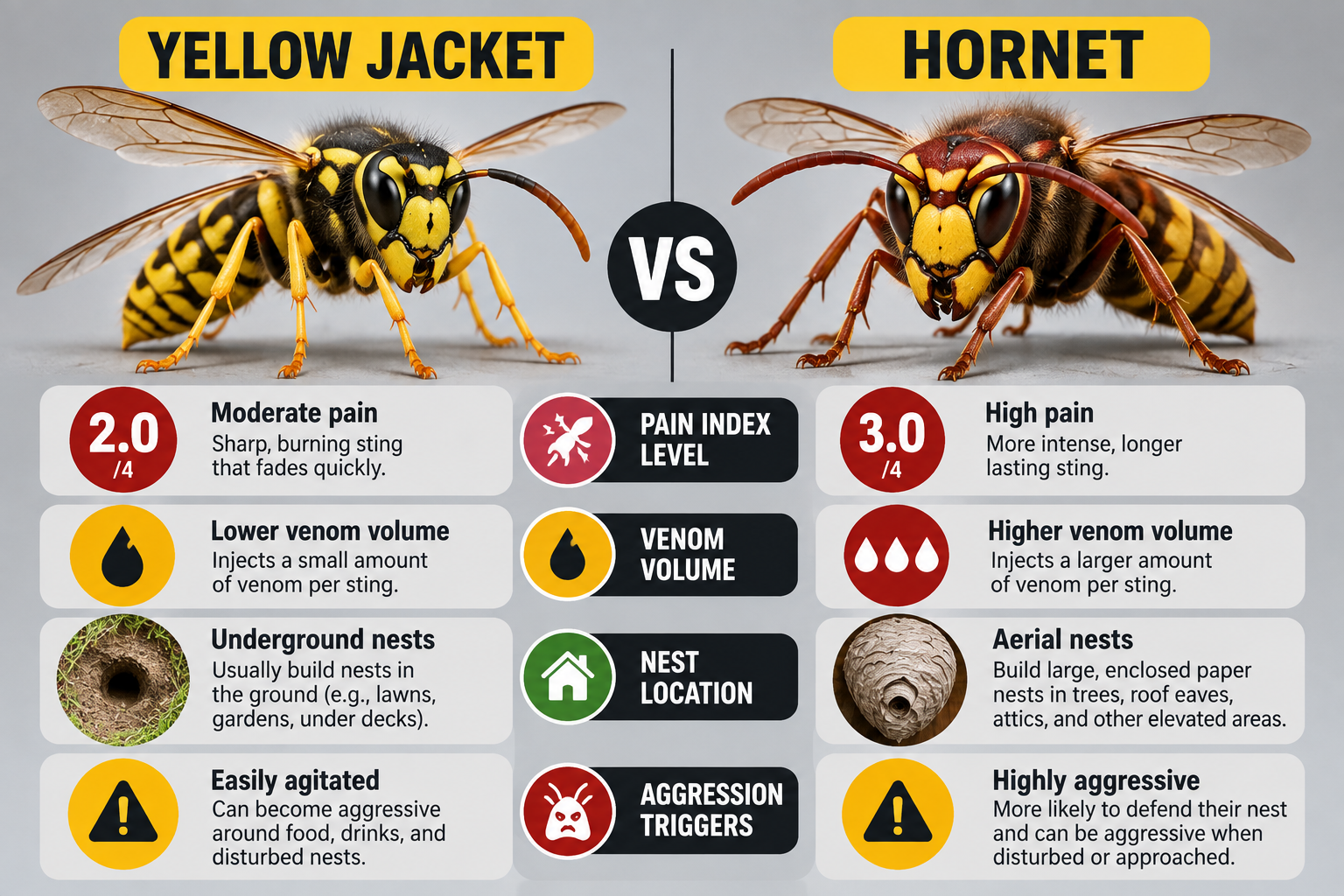
Pain Level: Yellow Jacket vs Hornet Sting
Entomologist Justin Schmidt developed the Schmidt Sting Pain Index to describe and compare the pain associated with insect stings. The scale ranges from 1 to 4, with higher numbers representing more intense pain.
- Western yellow jacket: Approximately 2 out of 4. Its sting can cause immediate burning or sharp pain.
- Bald-faced hornet: Approximately 2 out of 4. Its sting can also be sharply painful and produce local redness and swelling.
These ratings compare sting pain. They are not measures of allergy risk or guaranteed predictions of how an individual will react. Sting location, number of stings, species, and individual sensitivity can all influence the experience.
The Natural History Museum’s explanation of the Schmidt Sting Pain Index provides additional background.
Does Hornet Venom Make the Sting Worse?
Yellow jacket and hornet venoms contain biologically active substances that contribute to pain, inflammation, and other reactions. However, venom composition varies among species. It is not accurate to claim that every hornet sting delivers two or three times as much venom as every yellow jacket sting.
More importantly, sting pain and allergic danger are different questions. Someone with a serious venom allergy can develop a life-threatening reaction even after a single sting.
Comparison Table: Yellow Jacket vs Hornet Sting
| Feature | Yellow Jacket | Bald-Faced Hornet |
|---|---|---|
| Schmidt pain rating | Approximately 2/4 | Approximately 2/4 |
| Typical local symptoms | Sharp pain, redness, swelling, itching | Sharp pain, redness, swelling, itching |
| Ability to sting repeatedly | Yes | Yes |
| Common nest locations | Underground cavities, wall voids, sheltered spaces | Enclosed paper nests in trees, shrubs, and around buildings |
| Common defensive trigger | Disturbance close to the nest | Disturbance close to the nest |
| Severe allergic reaction possible? | Yes | Yes |
Identification note: Despite its common name, the bald-faced hornet is a type of aerial yellow jacket rather than a true hornet in the genus Vespa. This article uses it as the primary comparison because it is a familiar North American species.
Nest Defense and Why Multiple Stings Happen
Yellow jackets and bald-faced hornets live in colonies and may defend their nests when disturbed. Some species use chemical alarm signals that help recruit other workers during a defensive response.
Yellow jackets sometimes nest in underground cavities, where mowing, digging, or walking near an entrance can disturb the colony.
Bald-faced hornets more commonly build enclosed, papery aerial nests in trees, shrubs, or sheltered locations around buildings.
For help identifying these insects around your home, read our Pacific Northwest wasp and hornet identification guide .
If insects repeatedly enter a small gap in exterior siding, the nest may be concealed rather than visible. Our guide to yellow jackets in a wall explains warning signs and why sealing an active entrance can create additional problems.
Sting Symptoms and Swelling Timeline
Most stings cause a local reaction near the affected area. Symptoms and recovery times vary, so the following timeline is a general guide rather than a prediction for every person.
- Immediately after the sting: Sharp or burning pain, redness, and a small raised area may develop.
- Over the next 24–48 hours: Itching and swelling may become more noticeable. Some people develop a larger local reaction that continues to increase for a day or two.
- Over the following days: Mild reactions often improve, while larger local reactions can take several days or longer to settle.
Seek medical advice if swelling is extensive, symptoms are worsening unexpectedly, the sting involves a sensitive area such as the mouth or throat, or you have concerns about infection or an allergic reaction.
Important: A large local reaction does not automatically mean anaphylaxis. However, symptoms affecting breathing, circulation, or multiple body systems require immediate emergency attention.
First Aid for Yellow Jacket and Hornet Stings
If someone is stung and does not have signs of a severe allergic reaction, these basic steps may help:
- Move away from the nest: Leave the area promptly to reduce the chance of additional stings.
- Check for a retained stinger: Yellow jackets and hornets generally do not leave their stingers behind. If one is visible, remove it promptly without delaying care.
- Clean the area: Gently wash the sting site with soap and water.
- Apply a cold compress: Use a cold pack wrapped in cloth for short intervals to help with pain and swelling.
- Consider appropriate symptom relief: Over-the-counter medicines may help with discomfort or itching when used according to their labels and individual medical advice.
- Watch for changing symptoms: Monitor for breathing difficulty, widespread hives, faintness, throat tightness, or other signs of a serious reaction.
For additional outdoor safety guidance, see the CDC/NIOSH information on bees, wasps, and hornets.
Emergency Warning: Signs of Anaphylaxis
Call 911 immediately if someone develops difficulty breathing, wheezing, throat or tongue swelling, fainting, severe dizziness, or symptoms suggesting a serious allergic reaction after a sting.
If the person has been prescribed an epinephrine auto-injector for anaphylaxis, use it promptly according to their emergency action plan. Epinephrine is the first-line treatment for anaphylaxis; antihistamines are not a substitute.
Emergency medical evaluation is still necessary even if symptoms improve after epinephrine.
What to Do If You Find a Yellow Jacket or Hornet Nest
If you discover an active nest close to a doorway, play area, roofline, or frequently used part of the yard, avoid disturbing it.
- Keep children and pets away from the nest entrance.
- Avoid striking, shaking, digging into, or spraying the nest without appropriate training.
- Never attempt to burn a nest or pour gasoline into a nesting cavity.
- Do not seal an active wall entrance before the colony has been properly addressed.
- Ask a qualified local pest-control provider whether identification, treatment, or removal is appropriate for the situation.
Professional assistance can be especially important for concealed wall nests, nests near heavily used entrances, and situations involving a household member with a known sting allergy.
Frequently Asked Questions
Does a hornet sting hurt more than a yellow jacket sting?
Not necessarily. The western yellow jacket and bald-faced hornet both receive an approximate rating of 2 on the Schmidt Sting Pain Index. Individual experiences can vary.
How long does swelling last after a yellow jacket or hornet sting?
Mild swelling may improve within a few days. Larger local reactions can continue to increase for 24–48 hours and may take several days or longer to resolve. Seek medical advice for concerning or worsening symptoms.
Can yellow jackets and hornets sting more than once?
Yes. Unlike honeybees that commonly leave a barbed stinger behind, yellow jackets and hornets can usually sting repeatedly.
Can a single sting cause anaphylaxis?
Yes. A person with a severe venom allergy may develop anaphylaxis after a single sting. Suspected anaphylaxis is a medical emergency requiring immediate treatment.
Are bald-faced hornets actually hornets?
Bald-faced hornets are commonly called hornets, but scientifically they belong to a group of aerial yellow jackets. They are recognized by their black-and-white markings and enclosed paper nests.
Should I remove a hornet or yellow jacket nest myself?
Disturbing an active nest can trigger multiple defensive stings. For nests close to living areas, hidden inside structures, or otherwise difficult to access, consult a qualified local pest-control provider.
Related Homeowner Guides
If you are unsure what kind of stinging insect is present, these additional guides may help:
- Who to Call for Wasp Nest Removal: Pacific Northwest Guide
- Yellow Jackets in a Wall: Signs, Sounds, and What to Do