🚨 Active Wasp Nest or Yellow Jacket Emergency in Western Washington?
Do not risk painful multi-sting swarms. Connect directly with licensed regional exterminators serving Seattle, Tacoma, and Puget Sound ZIP codes by calling (833) 764-0523.
If you have discovered an active stinging insect nest on your property and are wondering who to call for wasp nest removal, taking immediate action before colonies reach peak seasonal aggression is essential. As late summer transitions into crisp autumn weather across Western Washington, yellow jacket and hornet populations surge while natural nectar sources dwindle, driving worker insects to aggressively scavenge near human living spaces.
Determining who to call for wasp nest removal is the most critical decision a homeowner can make when nests appear near entryways, soffits, or bedroom windows. While store-bought aerosol sprays are widely marketed at local hardware stores, improper DIY attempts frequently trigger defensive swarm attacks or force nest-building insects deeper into wall voids.
This comprehensive guide details how to identify Western Washington’s primary stinging insect species, explains official state health guidelines, outlines why DIY treatments fail, and explains how to connect with licensed local exterminators through our regional dispatch line at (833) 764-0523.
Pacific Northwest Stinging Insect Comparison Matrix
Correctly identifying the pest before taking action ensures safe treatment and prevents the accidental destruction of beneficial, protected pollinators like honeybees.
| Species Name | Body Markings | Nest Architecture | Common Locations | Aggression Level | Extermination Eligibility |
|---|---|---|---|---|---|
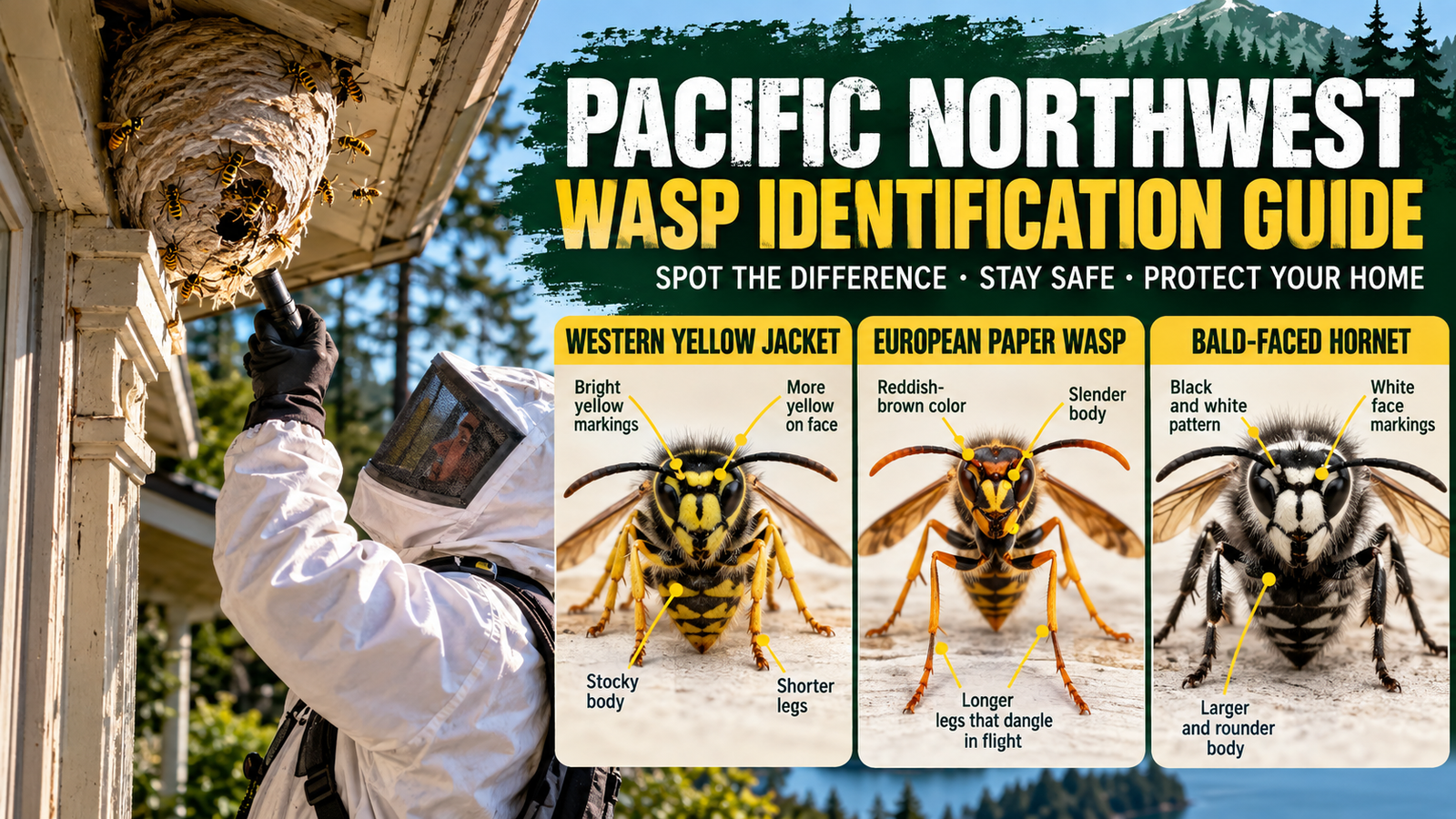
| Western Yellow Jacket | Bright yellow & black bands; hairless body. | Papery envelope with hidden combs. | Underground burrows, wall voids, soffits. | High (Defensive Swarms) | Eligible for Control |
| European Paper Wasp | Slender black/yellow; long dangling legs. | Open umbrella-shaped comb (no envelope). | Eaves, porch overhangs, deck railings. | Moderate (Stings if Disturbed) | Eligible for Control |
| Bald-Faced Hornet | Large black body with ivory/white facial markings. | Large, gray football-shaped paper nest. | High tree branches, attic gables, soffits. | Extreme (Multi-Sting Attacks) | Eligible for Control |
| Honeybee (Protected) | Fuzzy, amber/brown body with subtle stripes. | Wax honeycomb structure. | Tree hollows, chimney cavities, wall voids. | Low (Only Stings when Stepped On) | DO NOT SPRAY (Relocate Only) |
Identifying PNW Wasp, Hornet & Yellow Jacket Species
1. Western Yellow Jackets (Vespula pensylvanica)
Yellow jackets are responsible for the vast majority of late-summer outdoor sting incidents across the South Puget Sound region. These opportunistic pests build large paper nests enclosed in a protective paper pulp sheath. In urban and suburban areas like Seattle and Tacoma, yellow jackets routinely construct nests in abandoned rodent burrows underground, inside hollow concrete blocks, or within wall cavities entered through exterior utility gaps.
2. Paper Wasps (Polistes dominula)
Paper wasps are characterized by their slender waists and long legs that dangle below their bodies during flight. Unlike yellow jackets, paper wasps build open, single-layer umbrella nests where individual egg cells remain completely visible from underneath. They commonly nest under window sills, door frames, and outdoor furniture.
3. Bald-Faced Hornets (Dolichovespula maculata)
Technically a species of yellow jacket, the bald-faced hornet is distinguished by its large size and striking white-and-black coloration. Bald-faced hornets construct massive gray paper nests that can grow to the size of a basketball. Because these hornets aggressively defend their nest perimeter up to 15 feet away, aerial nest removal requires specialized personal protective equipment (PPE).
🍯 Who to Call for Wasp Nest Removal vs. Honeybee Relocation
Honeybees (Apis mellifera) are vital agricultural pollinators protected under local environmental guidelines. Licensed pest control operators in Washington State do not exterminate honeybee hives.
If you observe fuzzy, amber-colored bees clustering in a dense swarm or building a wax honeycomb, contact a local beekeeper for humane swarm removal. You can locate volunteer swarm collectors through the official Washington State Beekeepers Association swarm directory.
Why DIY Wasp Sprays Fail (And Cause Chewed Drywall Disasters)
Homeowners often attempt to eliminate wasp nests using store-bought aerosol foaming sprays or by sealing exterior entry holes with expanding spray foam. However, these DIY methods frequently result in severe injuries or interior structural damage for two primary reasons:
- Unbarbed Stinger Swarms: Unlike honeybees—which possess barbed stingers that detach after a single sting—yellow jackets, wasps, and hornets have smooth stingers allowing a single insect to sting repeatedly. Disrupting a nest with consumer aerosol sprays provokes an immediate pheromone-driven alarm signal, prompting hundreds of guard insects to swarm out simultaneously.
- The “Chewed Drywall” Indoor Intrusion: When homeowners seal an active exterior wall void entry hole using expanding foam or caulk without first eradicating the internal colony, worker insects cannot escape outdoors. Desperate for an exit, yellow jackets will use their powerful mandibles to chew directly through interior bedroom or living room drywall within 48 to 72 hours, releasing hundreds of trapped wasps into the living quarters.
If wasps are entering through foundation cracks or siding gaps, consult our complete Tacoma foundation sealing and structural exclusion guide after the active colony has been professionally eradicated. Securing exterior soffit gaps also mirrors the structural sealing techniques used in our attic and crawl space sealing protocol. Additionally, just as with rodents, understanding why DIY repellent sprays fail prevents homeowners from wasting time and money on ineffective home remedies.
Who to Call for Emergency Wasp Nest Removal
Connect with licensed exterminators in your ZIP code for professional nest treatment and removal.
📞 Call Regional Dispatch: (833) 764-0523Who to Call for Wasp Nest Removal in Washington State
When deciding who to call for wasp nest removal, homeowners often wonder which local entity handles stinging insect emergencies:
- Municipal & County Health Departments: City health departments (such as Seattle-King County Public Health or Tacoma-Pierce County Health Department) do not perform private pest control or nest removal services on private residential property.
- City Animal Control: Municipal animal control officers handle domestic animal welfare and stray pets; they do not remove stinging insect nests from residential structures.
- Licensed Pest Control Services: Knowing who to call for wasp nest removal ensures a professional exterminator licensed by the Washington State Department of Agriculture (WSDA) executes safe treatment. Professional technicians utilize protective suits, specialized insecticidal dusts, and telescoping equipment to eliminate active nests without danger.
According to health safety guidelines from the Washington State Department of Health and integrated pest management standards from the US Environmental Protection Agency (EPA), professional removal eliminates the immediate health risk while preventing recurring nest construction in subsequent seasons. Additional species identification support is provided by the WSU Extension stinging insect identification guide.
To check immediate service availability for local pest control services in Western Washington, call our regional dispatch line at (833) 764-0523.
Frequently Asked Questions
Who to call for wasp nest removal in Washington State?
When deciding who to call for wasp nest removal in Washington State, choose a licensed exterminator reached through a regional dispatch line like (833) 764-0523. Professional pest control technicians possess the necessary protective clothing, micro-encapsulated dusts, and specialized tools to eliminate nests without risking sting injuries.
Will city or county vector control remove a wasp nest from my house?
No. Municipal animal control and county health departments in Washington State do not perform pest removal services on private residential property. Homeowners are responsible for contracting private licensed exterminators for nest eradication.
What is the difference between a yellow jacket and a hornet?
Yellow jackets are smaller, hairless insects with bright yellow and black bands that frequently build underground or wall-void nests. Bald-faced hornets are larger, black-and-white insects that build large, aerial gray paper nests in trees and under eaves.
Do exterminators kill honeybees in Washington?
No. Licensed exterminators do not kill honeybees because they are protected pollinators. If you have a honeybee hive, contact the Washington State Beekeepers Association to connect with a local beekeeper for humane swarm relocation.
Why shouldn’t I seal a wasp nest entry hole with spray foam?
Sealing an exterior entry hole while a colony is active traps thousands of wasps inside wall voids. Unable to escape outdoors, yellow jackets will chew through interior bedroom or living room drywall, releasing aggressive insects directly into your home.
Protect Your Home & Family from Stinging Pests
Call our regional dispatch line to verify local provider connections across participating Washington State ZIP codes.
📞 Call (833) 764-0523 Now